
The Delulu Blog
Ox Alpha: The Anonymous AI Model That Let the Product Sell Itself

Most AI launches ask you to believe a story before you touch the product. Ox Alpha inverted the order: developers tried a capable model first, formed an opinion, and only then learned whose product they had been using.
On August 20, 2026, an anonymous model appeared on OpenRouter under stealth/ox-alpha and in OpenCode's Zen catalog. The OpenCode launch post offered it free for the next week, with a 1M context window, multimodal input, generous limits, and near-unlimited usage. OpenRouter described a reasoning model for coding, sustained agentic work, and production workloads. Its page listed text, image, and video input, a 1,048,576-token context limit, tools, and a 131,072-token maximum output.
The provider was not named. The product was.
On August 26, Z.ai published GLM-5.3-Flash and said it had tested the model anonymously as ox-alpha on OpenCode and OpenRouter “to gather user feedback.” The company describes the release as its first natively multimodal GLM-5 model, with 320 billion total parameters and 18 billion active parameters. The named release added public weights, a license, documentation, and pricing. OpenRouter's historical page now identifies the anonymous provider as ZAI.
There is a recent precedent. OpenRouter's historical Pony Alpha page identifies that February 2026 stealth model as an early testing version of GLM-5. That does not prove the two launches used an identical internal playbook, but it shows that anonymous previews were already a recognizable distribution pattern around the GLM family.
What developers actually saw during the anonymous week
The anonymous period was short, but it was not a teaser page with a waitlist. It was a working endpoint inside tools developers already used.
OpenCode's launch post promised a week of free access, 1M context, multimodal capability, zero data retention on that route, generous rate limits, and enough capacity to handle 100 trillion tokens per day. That is OpenCode's route-level claim, not a blanket promise about every intermediary. OpenRouter's historical page separately said prompts and completions were retained by the provider but not used for training. Different routes had different terms, which is why anonymous infrastructure should be treated as an evaluation surface rather than a production counterparty.
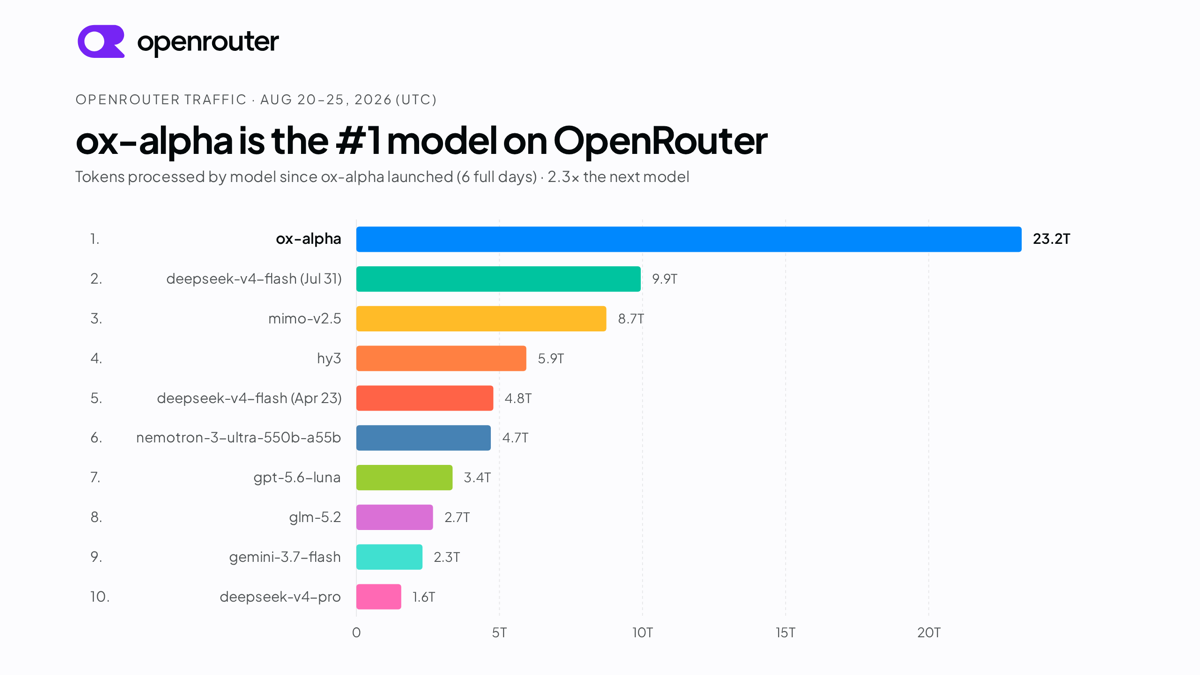
OpenRouter's official model-activity endpoint records 343,487,926 requests between August 20 and 26, plus 27.249 trillion prompt-and-completion tokens and 201.3 million tool calls. August 25 was the peak completed day at 78,997,598 requests. Those are platform telemetry, not unique developers, accepted code, revenue, or proof that the model was the best available. Long-context agent loops can generate many requests and reread the same context. Free access also creates a mechanical advantage in token-volume rankings.
Still, the numbers establish something useful: people put the model inside real workflows at scale.
The surrounding conversation was similarly practical. Developers shared coding runs, compared it with familiar models, and tried to work out who had built it. Community fingerprinting was not proof, but it was more serious than vibes. The open-source modelprint project reported that Ox Alpha matched z-ai/glm-5.3 on six of nine infrastructure probes and all four normalized tokenizer probes in its published run. That narrowed the family. It did not establish ownership. A signed release from Z.ai did that.
The reveal was the point, not the punchline
Z.ai's reveal completed a sequence that looks almost backwards compared with normal technology marketing:
Anonymous → Free → Capable → Word of mouth → Speculation → Reveal → Low-priced product
The confirmed motive is feedback. Z.ai says it ran an anonymous test to gather user feedback before release. My interpretation is that the structure also changed the evaluation environment. Before the reveal, a developer did not have to process the usual signals first:
- Z.ai, a Chinese AI company
- the GLM family name
- benchmark claims
- an existing reputation
- assumptions about Chinese models
- a price that might imply “cheap” or “not serious”
That does not mean every developer carries those assumptions, or that Z.ai designed the test specifically to defeat anti-Chinese bias. I found no primary statement saying that. It means anonymity removed some information that normally arrives before product experience, whether those signals would have helped or hurt.
The order became: try it, judge it, form an opinion, discover who made it.
That is a blind product test with an unusually useful sample. The “sample” was not a lab panel asked to sip two unmarked sodas. It was developers handing a model repositories, screenshots, tool calls, issue histories, and long-running tasks. The work was messy enough to expose failure modes that a launch demo can hide.
Most AI launches ask the market to trust the chart and then try the model. Ox Alpha let the trial become the marketing.
I formed my opinion before I knew the name
I was one of the developers who tried Ox Alpha during the anonymous, free period. I used it on real development work, not just benchmark-style prompts. It impressed me enough that I kept giving it meaningful tasks.
Once paid access became relevant, I was able to complete numerous development tasks at extraordinarily low cost. Some individual workloads cost pennies, or a fraction of what I have become accustomed to paying for frontier-model development work. I am not presenting that as a controlled benchmark or a universal savings claim. It is a personal operating observation.
The more important observation is simpler: I formed my opinion of the product before I knew whose product it was.
That makes my experience a small, imperfect example of the larger thesis. The model earned a place in my workflow before its parent company entered my judgment.
Why the China factor matters, carefully
Chinese AI companies can enter Western technology markets carrying perceptions that have little to do with a specific output: questions about privacy, security, geopolitics, censorship, copying, trust, or whether American frontier labs remain technologically superior. None of those concerns is imaginary, and none applies equally to every buyer. But perception changes whether someone samples a product at all.
That is the awkward commercial problem. What do you do when a customer may reject the label before evaluating the product?
One answer is to let the product arrive before the label.
Ox Alpha created a temporary environment where output could establish credibility before Z.ai's identity entered the equation. Again, that is analysis, not a claim about Z.ai's stated reason. The company has explicitly said “gather user feedback.” The brand-blind effect is what the launch structure made possible.
This is the same reason blind tests exist in other categories. Remove a cue, and you learn how much of the judgment belonged to the thing itself versus the story wrapped around it.
The price reveal lowered the second barrier
Anonymity removed one kind of friction. Free access removed another. The named release then had to solve the normal problem of keeping people who had already tried it.
As of August 27, Z.ai's direct API pricing lists GLM-5.3-Flash at $0.15 per million input tokens, $0.03 per million cached input tokens, and $0.50 per million output tokens. Z.ai is running a 50% launch promotion through September 9, 2026 at 24:00 UTC+8, bringing those rates to $0.075, $0.015, and $0.25. OpenRouter's live page shows the same promotional rates. GLM-5.3 is listed on OpenRouter at $1.40 per million input tokens and $4.40 per million output tokens, making Flash about 5.4% of the input price and 5.7% of the output price while the promotion lasts.
Price is not proof of quality. It is a reason to keep testing.
The release also gives developers more durable options. Z.ai says the weights are public on Hugging Face, and the official model card carries an MIT license with local deployment paths through SGLang, vLLM, and TokenSpeed. That fits the local-first AI direction we have been tracking, although the direct API, OpenRouter route, third-party hosts, and self-hosted weights are not the same operational or data-governance decision. A named model still needs due diligence.
Was the strategy successful?
We can answer that in layers.
The stealth launch clearly generated trial. OpenRouter telemetry shows hundreds of millions of routed requests during the preview week. It generated attention and discussion. Developers tried to fingerprint it, compare it, and fit it into agent workflows. Z.ai says it became OpenRouter's most popular model of the week.
We can also say the reveal generated a clean story: the mystery model was an early GLM-5.3-Flash, not a random anonymous provider that happened to resemble GLM.
What we cannot responsibly say yet is that the strategy produced durable commercial success. We do not have verified post-reveal retention, revenue, enterprise adoption, or a controlled comparison with the behavior developers would have shown if the model had launched under the Z.ai name. The evidence supports trial, attention, and discussion. Paid adoption remains an open question.
That is not a weak conclusion. It is the difference between a distribution win and a business win.
Where else could this work?
The pattern is useful beyond AI. It also fits the broader shift toward systems that turn attention into repeatable growth, rather than one-off campaign spikes. A company may benefit from blind or low-context sampling when it has:
- a damaged or unknown brand
- an unfashionable country of origin
- a category customers dismiss
- an incumbent product people assume is inferior
- a technically excellent product buried under a weak reputation
- a parent company whose reputation distorts evaluation
The move is not “hide forever.” It is to create a legitimate moment in which the product can be experienced before the brand dominates the judgment.
That might mean a blind comparison, an unbranded trial, a community beta, a white-label pilot, or a free tier that lets customers complete a real job. The mechanism is product-led growth in its most literal form: the product creates the next conversation.
But this strategy has a harsh requirement. The product has to be good.
Anonymity cannot permanently rescue a weak product. In fact, removing the brand makes the product carry more of the burden. There is no reputation halo, founder charisma, benchmark narrative, or category expectation doing the work for it.
That is what makes Ox Alpha interesting. Z.ai was willing to let developers judge the model before the company asked them to care about the name.
The lesson for anyone launching anything
Before your next launch, ask which signals reach the customer before the product does.
Does the customer see your reputation before your work? Your price before your value? Your country of origin before your result? Your category label before your actual experience?
Sometimes those signals are assets. Sometimes they are a tax.
If they are a tax, a carefully designed trial can change the order of operations. Remove friction. Let people do a real task. Give them enough time to form an opinion. Then reveal the brand and offer a rational next step.
The same approach applies internally. A product team can ask people who were not in the room to test a finished concept without the explanation. If they need the story told before they can see the value, that is information. It is not a failure on the audience's part.
Ox Alpha's launch did not prove that brand does not matter. It proved that product experience can sometimes arrive first.
And when a market may reject your label before it evaluates your work, that reversal can be the entire strategy.
Research Confidence
This article separates high-confidence facts from interpretation. The anonymous OpenRouter/OpenCode launch date, route specifications, Z.ai's identity confirmation, feedback-gathering statement, model specifications, license, and current pricing are drawn from primary platform and company documentation. OpenRouter traffic figures are route telemetry from its official but undocumented activity endpoint, so they measure requests and tokens, not unique users, revenue, accepted work, or model quality. Fingerprinting is cited as reproducible community evidence that narrowed the model family before the reveal, not as proof of ownership. The brand-blind and China-factor analysis is Design Delulu's interpretation of the launch structure, not a statement of Z.ai's internal motive.
Confidence Level: Normal
FAQ
What was Ox Alpha?
Ox Alpha was an anonymous, free preview model released on OpenRouter and OpenCode on August 20, 2026. It offered a roughly one-million-token context window, multimodal input, tool use, and coding and agent capabilities.
Who made Ox Alpha?
Z.ai confirmed on August 26, 2026 that Ox Alpha was an early version of GLM-5.3-Flash, tested anonymously to gather user feedback.
How much does GLM-5.3-Flash cost?
As accessed August 27, 2026, Z.ai listed GLM-5.3-Flash at $0.15 per million input tokens, $0.03 cached input, and $0.50 output. A 50% promotion runs through September 9, 2026 at 24:00 UTC+8.
Was Ox Alpha actually successful?
The launch clearly generated trial, attention, and developer discussion. Verified post-reveal retention, revenue, and durable paid adoption are not yet available, so commercial success remains an open question.
Can an anonymous product launch work outside AI?
It can work when a legitimate trial lets customers experience a strong product before brand reputation, category assumptions, or country-of-origin cues dominate judgment. Anonymity cannot permanently rescue a weak product.
Ready to turn attention into customers?
Book a free discovery call and let's map your growth system.
Free Marketing AuditOr book a strategy call