
The Delulu Blog
The Future of AI May Not Be in the Cloud. It May Just Be Your Computer.

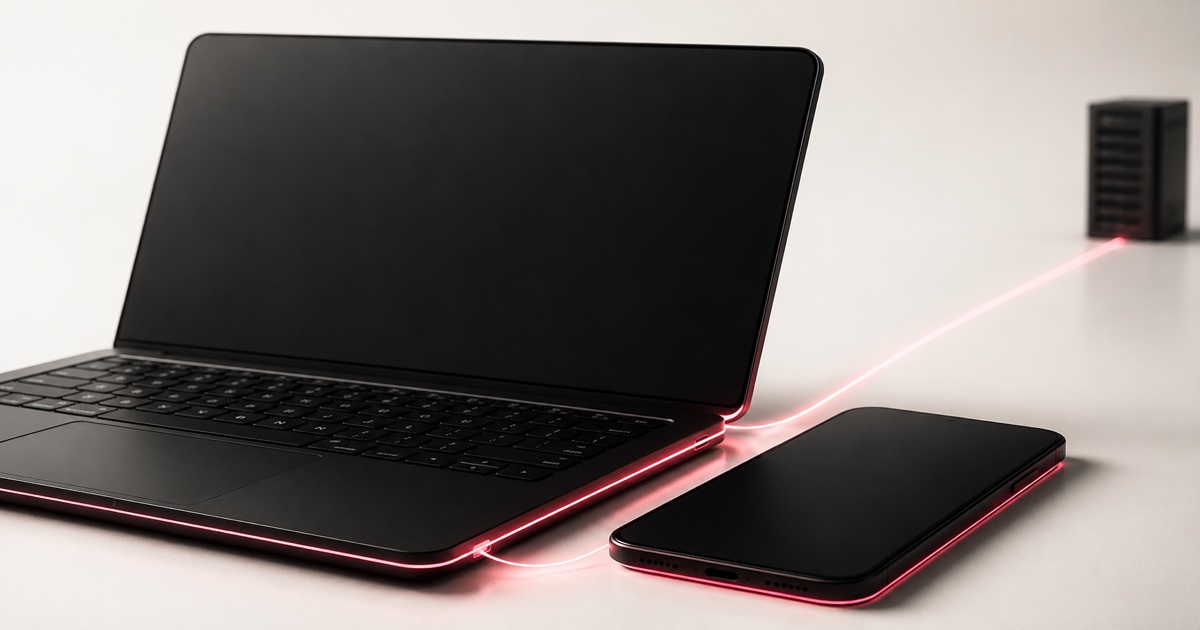
"I'm using ChatGPT." "I'm using Claude." "I'm using Gemini." Say any of those out loud and everyone knows exactly what you mean: you went somewhere, on purpose, to talk to a specific thing.
That sentence structure is temporary. Not because any of those products are going away, but because naming the AI you're using only makes sense while using AI still feels like visiting a separate destination: a tab, an app, a website you consciously opened. The prediction in this piece is that the destination framing fades as local capability keeps improving, and AI starts feeling less like a place you go and more like a layer the computer itself just provides, the way spellcheck or a search index stopped being a "tool you open" decades ago and became something the operating system just does.
This isn't a claim that local AI replaces cloud AI. The capability evidence doesn't support that, and neither does the infrastructure evidence: frontier training and the hardest reasoning work are staying centralized for the foreseeable future. What's actually taking shape, in real shipping products as of 2026, is something more specific: local intelligence as the default layer for everyday work, with cloud intelligence as an escalation layer for whatever genuinely needs it.
What "hybrid" actually means in a real 2026 product
This isn't a thought experiment. Perplexity introduced what it calls a hybrid local-server inference orchestrator at Computex 2026, built specifically to route AI tasks automatically between on-device and cloud models without asking the user to decide in advance. In its announced implementation, a local model running on-device (Intel's Core Ultra Series 3 was the reference hardware) makes the first call: it decides what information should stay on the device and what can be sent to a cloud-based frontier model, before any request actually leaves the machine. The user experience is a single assistant. The architecture underneath it is two tiers, with a router deciding, per request, which tier actually handles it.
That pattern (local by default, cloud on escalation) is showing up as the emerging standard rather than a one-off experiment. Three separate forces are pushing it there at the same time, and none of them are speculative:
- Privacy regulation. The EU AI Act's data-residency requirements took effect August 2, 2026, adding real legal weight to keeping certain categories of data from leaving a device by default, not just a preference, a compliance requirement in a major market.
- Cost. Production AI agent systems routinely generate thousands of model calls per user per day once they're doing real multi-step work rather than answering single questions. Routing all of that through a frontier cloud model, unconditionally, is becoming economically unsustainable at scale for anyone shipping agentic products, which is a cost pressure pushing toward local-first by default, not by ideology.
- Latency. Agentic loops that chain five to fifteen model calls to complete a single task compound network round-trip time into delays a user actually notices. A local model handling the routine steps in that chain, escalating only the step that actually needs more capability, is measurably faster than sending every step to the cloud.
None of those three forces are about AI capability at all. They're about economics, law, and physics, which is exactly why this shift looks durable rather than trend-driven. Capability arguments go out of date every model release. Cost, regulation, and the speed of light don't.
The layer this actually becomes: local default, cloud escalation
The clean way to describe the architecture emerging across 2026's early implementations: a local model handles the request first. If it's confident and capable enough (routine drafting, a straightforward question, a simple coding task, anything the device can do well) it answers directly, with no round trip, no per-query cost beyond electricity already being spent, and no data leaving the device. If the request needs more (deeper reasoning, broader context, a capability the local model genuinely doesn't have) it escalates to a cloud-based frontier model, transparently, the way a support call sometimes gets escalated to a specialist without the customer having to ask for it by name.
That's a meaningfully different prediction than "local AI wins." It's closer to how compute has actually organized itself at every previous inflection point: your phone doesn't render every photo in a data center, but Photoshop's heaviest generative features still sometimes call out to cloud compute; your laptop doesn't index the entire internet locally, but it caches and predicts locally to make search feel instant. AI settling into that same two-tier pattern isn't a radical departure from how computing already works: it's AI catching up to a structure computing already uses everywhere else.
What has to be true at the OS level for this to actually happen
A router deciding "local or cloud" per request only works if the operating system, not just one app, is making that decision, which is why the real signal to watch is OS-level integration, not any single product's feature. 2026's "AI PC" hardware race is the infrastructure for exactly this: Qualcomm's Snapdragon X2 Elite pushing to roughly 80 TOPS of dedicated neural processing, Apple restructuring the M5 generation around Neural Accelerators embedded in every GPU core rather than one separate block, both vendors explicitly building for on-device model execution as a first-class OS capability rather than an app-level bolt-on. Windows' own 2026 platform direction has been described around exactly this framing: agentic AI and hybrid compute as something the operating system coordinates, not something each app reinvents separately.
That matters because routing decisions need context an individual app usually doesn't have: what's already on the device, what the user's privacy settings actually say, what's currently cached locally versus what would need a network call. An OS-level AI layer can see all of that. A single chatbot app, no matter how good, structurally can't: it only sees its own conversation. The shift from "AI app" to "AI layer" is, underneath the marketing language, a shift in which part of the software stack owns the routing decision.
Your files stop being something you "attach"
A smaller, more concrete version of this shift is already visible in how personal context gets handled. Today, using AI on your own documents usually means an explicit act: uploading a file, pasting text, granting an app access to a folder. That's a destination-model interaction: you go to the AI and hand it something. A local-first layer inverts that by default, because the model doesn't need a network call to see what's already on the device it's running on. Personal files, local search history, installed applications, and on-device context become ambient inputs a local model can reason over directly, with cloud escalation reserved for the specific piece of a request that actually needs it, not the whole file, not the whole context, just the part that genuinely exceeds local capability.
That has a real consequence for application design, not just for privacy. Software stops needing to build its own AI feature from scratch inside every app: the way, today, a note-taking app, a browser, and an email client each ship separate, competing "AI assistant" integrations. If the OS owns a routing layer that already has access to local files and context, individual applications can call into that shared layer instead of each reimplementing it, the same way applications today call a shared spellchecker instead of shipping their own. That's a plausible, not yet proven, shift in how software gets built: worth naming honestly as a bet, not a fact.
What changes for privacy, cost, and the software you use
| Dimension | Today (cloud-first default) | Emerging (local-first, cloud-escalation) |
|---|---|---|
| Personal files, messages, photos | Often processed via cloud API, subject to that provider's data policy | Processed locally by default; only escalated content leaves the device |
| Cost per routine query | Metered against a cloud API budget, at scale | Effectively free at the margin once hardware is owned |
| Offline capability | Breaks or degrades without connectivity | Routine work keeps functioning; only escalation requires a connection |
| Latency on multi-step agentic tasks | Compounds with every round trip in the chain | Local steps are near-instant; only escalated steps carry network latency |
| Regulatory exposure (data residency) | Real compliance burden for anything touching regulated data | Structurally reduced: the data in question often never leaves the jurisdiction, or the device |
| What still needs the frontier model | Everything, by default | Genuinely hard reasoning, broad context, and anything the local model honestly can't do |
Model routing is the real architecture decision, not "which model"
Most public conversation about AI in 2026 is still framed as "which model is best": Claude versus GPT versus Gemini versus an open-weight alternative, ranked like sports teams. That framing is going to matter less over time, not because model quality stops mattering, but because most users are going to stop making that choice directly at all. The choice moves up a level, from "which model" to "which router": which system decides, on your behalf and mostly invisibly, what should run locally and what should escalate, and how good that router's judgment actually is. A mediocre router sitting on top of great models produces a worse experience than a great router sitting on top of good-enough models, the same way a badly designed customer-service escalation policy can waste a brilliant specialist's time on tickets that never needed them.
That's a genuinely new kind of software quality to evaluate, and it's mostly unmeasured today. Nobody has a trusted, independent benchmark for "how good is this system's local/cloud routing decision," the way SWE-bench exists for coding capability. That's a real gap, and it's one of the more interesting open questions this cluster of articles doesn't have a clean answer for.
What's real today versus what's still a bet
To be direct about the boundary: on-device AI, quantized local models, and NPU-accelerated inference are real, shipping, and improving fast: that's not speculative, it's documented in the infrastructure piece and the capability piece in this cluster. Perplexity's Computex 2026 hybrid orchestrator is real and shipping, not a concept demo. What's still genuinely a bet is the specific claim this article is built around: that this becomes the *default, invisible architecture* most people experience, not a power-user feature, not an enterprise IT decision, but the ordinary way a laptop or phone behaves out of the box, the way autocomplete and spellcheck became invisible defaults rather than opt-in tools. That's a prediction about mainstream default behavior, not about whether the underlying technology works, and it deserves to be held to a higher bar than "the technology exists."
Why this matters more than it sounds like it should
There's a reason this framing sits comfortably with how we think about AI generally, not just as a forecast but as a belief: AI working best as infrastructure, not as the thing you consciously interact with, isn't a compromise: it's what mature, good infrastructure always looks like. Electricity stopped being a destination the day it became a wall outlet instead of a generator you had to walk to. The internet stopped being a destination somewhere between "dial-up as an event" and "always-on and invisible." If this prediction is right, AI's version of that same transition is already underway, and the products loudest about "using AI" today are describing the most visible, least mature phase of a technology that (like every infrastructure layer before it) is trying to disappear into the walls.
Research Confidence
This article is based on:
- Evidence: Perplexity's Computex 2026 hybrid orchestrator, the EU AI Act data-residency date, and the Snapdragon X2 Elite / Apple M5 hardware figures are drawn from named, dated vendor announcements and regulatory text, not projections
- Evidence: cost and latency pressures on agentic multi-call systems are drawn from independent industry reporting on production AI agent deployments, not a single vendor's framing
- Heuristic: the comparison to electricity and the internet becoming invisible infrastructure is Design Delulu's own reasoned argument, not a documented historical parallel study, offered as a framing rather than a proof
- Hypothesis: the 2028 OS-default prediction, and the broader claim that this becomes the default rather than a power-user feature, is explicitly forward-looking and unproven
Confidence Level: Normal
FAQ
Does "local-first AI" mean cloud AI goes away?
No. The prediction is a hybrid architecture: local models handle routine requests by default, and a router escalates genuinely hard requests to a cloud/frontier model. Frontier training and the hardest reasoning work stay centralized for the foreseeable future.
Is hybrid local/cloud AI routing already a real product, or just a concept?
It's real and shipping. Perplexity introduced a hybrid local-server inference orchestrator at Computex 2026, built to route AI tasks automatically between on-device and cloud models without the user deciding in advance.
Why would AI companies push work to local devices instead of the cloud?
Three non-speculative forces: privacy regulation (the EU AI Act's data-residency requirements took effect August 2, 2026), cost (unconditionally routing every agentic model call through a cloud API doesn't scale economically), and latency (chained agentic tasks compound network round-trip time).
What has to change at the operating-system level for this to happen?
Routing decisions need context an individual app doesn't have: what's on the device, current privacy settings, what's cached locally. That requires the OS itself, not a single app, to own the routing layer, which is what 2026's AI PC hardware (Snapdragon X2 Elite, Apple M5 Neural Accelerators) is built for.
When will AI stop feeling like a separate app and start feeling like part of the computer?
Design Delulu's own prediction, made in August 2026, is by 2028 for at least one mainstream consumer OS shipping local-first AI as an invisible default, not an enthusiast setting.
Ready to turn attention into customers?
Book a free discovery call and let's map your growth system.
Free Marketing Audit Or book a strategy call