
The Delulu Blog
AI's Data Center Problem Might Be Temporary

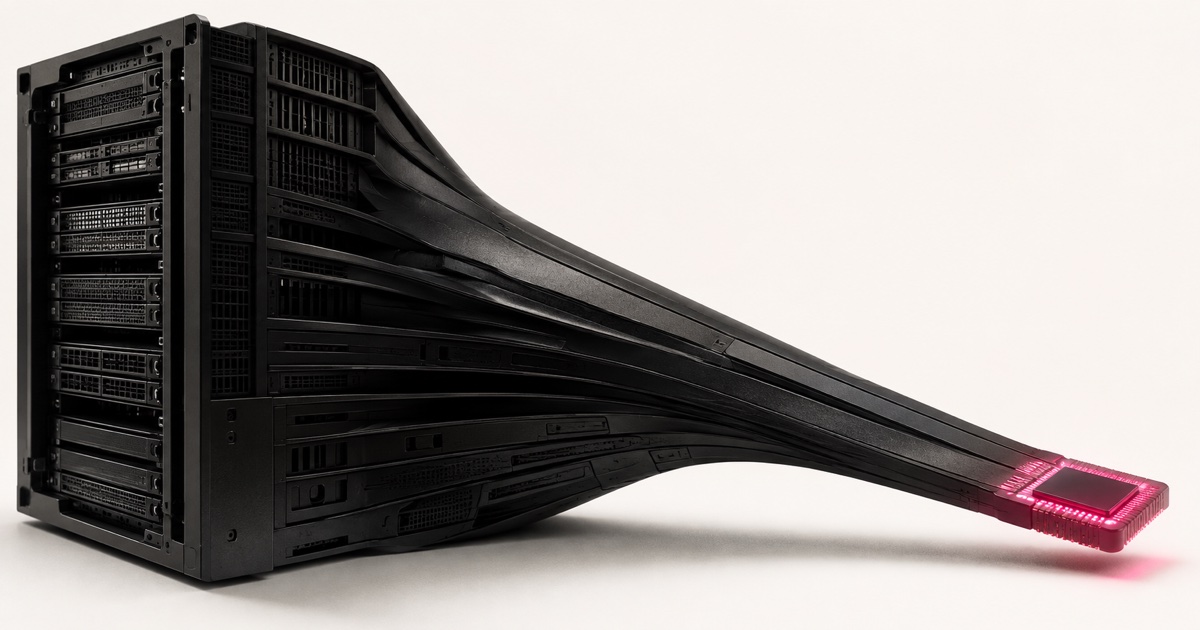
Every AI data center being built right now is being built to run today's models, on today's chips, with today's software. None of those three things are staying still.
That's easy to say and hard to sit with, because the environmental case against AI infrastructure isn't hypothetical. It's not a slippery-slope argument or a hypothetical someone's worried about. It's a real, measured, currently-happening draw on real power grids and real water tables, and pretending otherwise doesn't help anyone make a good decision. The question this article is actually asking isn't "is AI's environmental footprint a problem." It's a narrower, more useful one: are we quietly assuming that the infrastructure AI needs today is the infrastructure AI will need permanently, and is that assumption actually safe?
The number that's real right now
Start with what isn't in dispute. The International Energy Agency puts global data center electricity consumption at roughly 415 terawatt-hours in 2024 (about 1.5% of global electricity use) after five years of roughly 12% annual growth. By 2025 that figure had climbed to somewhere around 460–490 TWh, with total data center demand up 17% year-over-year and electricity consumption at AI-focused data centers specifically surging around 50% in the same period. The IEA's Base Case has global data center demand reaching approximately 945 TWh by 2030, just under 3% of global electricity consumption, growing at roughly four times the rate of every other sector combined. "Accelerated servers" (the GPU and AI-accelerator racks driving that curve) account for almost half of the entire net increase.
Water tells a similarly uncomfortable story. U.S. data centers were on pace to draw close to one trillion liters of water annually as of 2025, direct consumption that could double or quadruple 2023 levels by 2028 on some estimates. Roughly two-thirds of U.S. data centers built since 2022 sit in regions already under water stress. A single LLM response has been estimated to cost somewhere between 10 and 50 milliliters of water through evaporative cooling, depending on the facility, the climate, and the cooling design: a small number multiplied by a genuinely enormous number of daily queries.
None of that is exaggerated by critics. It's the IEA's own numbers, and a government-commissioned UK report's own numbers, and it's exactly why data center siting fights, water-rights disputes, and grid-interconnection backlogs have become real political stories in 2026, not abstract ones. Anyone building an argument about AI's future that starts by waving this away has already lost the argument.
The forecasting mistake worth naming
Here's the mistake we think is easy to make without noticing: treating 2026's AI infrastructure requirements as a stable baseline instead of what they actually are: the requirements of the least efficient version of this technology that will ever exist. Every model shipping today is, almost by definition, less efficient than the model that will do a comparable job a year from now. That's not an AI-specific claim; it's true of basically every computing technology in its buildout phase, from mainframes to the early internet to mobile networks. The infrastructure gets built for the current generation's appetite, and then the appetite per unit of useful work starts falling, often faster than the infrastructure narrative catches up with it.
The evidence that this is already happening with AI is not speculative. Epoch AI's research on algorithmic efficiency estimates that the compute required to hit a given level of model capability has been falling by something like 3x to 10x per year, depending on the estimation method: with a credible range that researchers themselves put as wide as 2x to 50x per year. That's an enormous uncertainty band, and it should be treated as one, but every independent estimate in that range points the same direction: getting the same intelligence out of a model is getting dramatically cheaper, in compute terms, year over year, on top of whatever hardware gets faster on its own. A separate 2026 analysis of inference pricing found the dollar cost of hitting a fixed benchmark score on reasoning, math, and coding tasks has been falling 5x to 10x annually. That compounding is the entire argument. If it holds for even a few more years, the "AI workload" that required a hyperscale data center in 2026 may require a fraction of that by 2030, not because AI got weaker, but because doing the same job got cheaper.
What's actually moving toward the device in your pocket
This isn't only a compute-efficiency story. It's also a hardware story, and the hardware is moving fast enough that "on-device AI" stopped being a slide in a keynote and started being a spec sheet. Quantization (compressing a model's weights from 16- or 32-bit precision down to 8-bit or 4-bit) routinely delivers 4x to 8x memory reduction while retaining 95%+ of the original model's accuracy on most tasks. That's the difference between "needs a server rack" and "runs on a laptop," for a meaningful slice of everyday AI work.
The chips are catching up to make that practical. Qualcomm's Snapdragon X2 Elite, launched at CES in January 2026, pushed its neural processing unit to roughly 80 TOPS; Qualcomm's flagship mobile chip claims around 100 TOPS. Apple restructured its M5 generation around dedicated Neural Accelerators built into every GPU core rather than a single separate Neural Engine block, leaning on unified memory architecture to make on-device inference genuinely fast rather than just technically possible. None of these numbers should be read as gospel: TOPS figures are notoriously gameable and don't map cleanly to real-world model performance, and mobile NPUs are still bottlenecked by memory bandwidth in the range of 50–90 GB/s, versus 2–3 TB/s on a data center GPU: a 30x to 50x gap that limits what "runs locally" actually means in practice today. But the trajectory is unambiguous: consumer hardware is being deliberately, aggressively redesigned around running AI workloads that used to require a round trip to somebody else's data center.
What probably stays centralized, and what probably doesn't
The honest version of this prediction isn't "local AI replaces the cloud." It's that AI workloads are likely to sort themselves by what actually needs a data center's scale, and that sorting cuts in a specific, predictable direction.
| Likely stays centralized | Likely migrates toward local/edge |
|---|---|
| Frontier model training: still the most compute-intensive step by a wide margin | Everyday drafting, summarization, and Q&A: the bulk of routine daily AI use |
| Long-horizon agentic reasoning across large, shared context | Simple, well-scoped coding assistance and autocomplete |
| Workloads that need the single most capable model available, regardless of cost | Privacy-sensitive tasks touching personal files, photos, or messages |
| Enterprise-scale inference serving millions of concurrent users | Offline or intermittent-connectivity use cases |
| Anything requiring coordination across many users' shared data | Latency-sensitive interactive tasks where a round trip is the bottleneck |
Whether that split actually happens at scale depends on a separate question this article isn't built to answer on its own: whether local models get genuinely capable enough to handle that "migrates local" column for real work, not just simple demos. We look at that capability question directly in the next piece in this series. That split matters because of where the actual energy is being spent today. Hyperscaler telemetry from 2024–2026 increasingly points to inference, not training, as the dominant share of AI's total energy footprint, with some estimates putting inference at 80–90% of total AI-related electricity use industry-wide, and Schneider Electric's own projections putting inference's share of AI compute load at roughly 85% by 2028. Training happens once per model. Inference happens every single time someone uses it, forever, at scale. If a meaningful share of that inference volume (the routine, everyday, unglamorous majority of it) moves off centralized infrastructure and onto local hardware that a consumer already bought for other reasons, that's not a rounding error. That's the fastest-growing, least fixed piece of the entire energy equation.
A distinction worth holding: democratization is not the same as decentralization
As of August 2026, open-weight models and free-access APIs are proliferating: DeepSeek V4-Pro with 96% frontier-class performance on open weights, Ox Alpha appearing as a stealth free-preview model positioned at frontier capability. This looks like democratization: capability spreading beyond a closed group of providers. It is. But democratization (many people can access frontier-class capability) is not the same as decentralization (that capability runs on their own hardware). A model becoming cheap or free and widely accessible through an API does not mean its inference has moved out of a data center: it just means more people are requesting inference from the same data center. That distinction matters for this article's thesis because it means the trend toward capability democratization does not automatically reduce data center load. It could accelerate it, if more people use more capable models more often. The infrastructure impact of this shift: whether decentralization (workloads actually moving to local hardware) or mere democratization (more API calls to centralized inference), is exactly the falsifiable prediction this article makes, and it's the one that actually determines whether AI's data center footprint grows or shrinks by 2030.
The honest tension: efficiency doesn't guarantee less consumption
This is the part of the optimistic version of this argument that gets skipped too often, and we're not going to skip it. The Jevons paradox (first named in 1865 about coal, and directly relevant to AI in 2026) describes something uncomfortable: making a resource more efficient to use often makes it cheaper and more accessible, which increases total consumption rather than reducing it. Research published in 2025 on AI's specific rebound effects makes the case explicitly: demand for AI compute has been growing faster than efficiency gains can offset, and in some framings the rebound effect exceeds 100%: meaning efficiency improvements have coincided with faster total resource consumption, not slower.
We think that's a real risk, not a theoretical one, and it's the strongest argument against the "efficiency saves us" version of this piece's own thesis. Cheaper, more efficient AI inference doesn't obviously reduce total energy draw: it makes AI cheap enough to put into products that didn't have it before, at a volume nobody planned for. The IEA's own 2035 scenarios reflect exactly this uncertainty: a "Headwinds" case lands around 700 TWh, a "High Efficiency" case lands around 970 TWh, and a "Lift-Off" case (more compute, more adoption, efficiency gains absorbed by demand growth rather than netting out) lands around 1,700 TWh. That's not a narrow band. That's the IEA itself saying the outcome depends heavily on exactly the dynamic this section describes, and nobody currently knows which scenario we're in.
There's a second honest tension worth naming: moving inference onto local hardware doesn't erase AI's environmental footprint, it relocates part of it. Every NPU-equipped phone, laptop, and "AI PC" carries its own embodied manufacturing footprint: semiconductor fabrication alone is estimated to produce roughly 185 million tons of CO2-equivalent emissions annually across the industry, and chips can represent something like 30% of the total carbon footprint of an AI-driven data center once you count embodied, not just operational, emissions. If local AI capability becomes a reason for faster device upgrade cycles (buying a new phone specifically because the old one's NPU can't keep up) that's a real cost, and one researchers have flagged as potentially reaching on the order of a gigaton of CO2 annually across the device ecosystem by 2027 on some projections. Local AI is not a free environmental pass. It's a different allocation of the same underlying problem, and a fair prediction has to say that plainly instead of hiding it in a footnote.
What would actually prove this right or wrong
A prediction that can't be checked isn't worth much, so here's what to watch instead of trusting our word for it. The IEA's Base Case (945 TWh by 2030) versus its High Efficiency Case (roughly 970 TWh by 2035, essentially flat past 2030) versus its Lift-Off Case (roughly 1,700 TWh by 2035) is the single clearest external scoreboard: if AI infrastructure demand tracks meaningfully below Base Case a few years out, something like this thesis is playing out. Watch whether major AI providers start defaulting consumer products to local inference rather than a cloud API call, the way several already began experimenting with hybrid local-cloud routing in 2026. Watch the ratio of on-device to cloud tokens processed, if anyone starts reporting it honestly. And watch whether the embodied-carbon side of this (device manufacturing and upgrade cycles) gets measured with anything close to the rigor data center energy now gets, because right now it mostly doesn't, and that's a real gap in the public conversation, not just this article's.
The honest position, today, is that AI's environmental footprint is real, current, and worth every bit of the scrutiny it's getting. It's also possible, not certain, but genuinely possible, on the evidence: that we're measuring AI's environmental future using the infrastructure requirements of its infancy. Both things can be true at once. The next few years of hardware and efficiency numbers, not this article, will decide which one turns out to matter more. If local inference does end up taking a real bite out of centralized demand, the more interesting question becomes what AI starts to feel like once it's running on the device in your hand instead of in a data center three states away: which is where this series goes next.
Research Confidence
This article is based on:
- Evidence: global data center energy and water figures are drawn directly from the IEA's own reports and a UK government-commissioned water-use study, named and dated primary sources
- Evidence: algorithmic efficiency, quantization, and hardware specifications are drawn from Epoch AI's research and named vendor/independent technical sources
- Heuristic: the framing that we're measuring AI's environmental future using the infrastructure requirements of its infancy is Design Delulu's own reasoned argument, offered for scrutiny rather than as an established consensus
- Hypothesis: the specific 2030 prediction is an explicitly forward-looking, falsifiable claim, not yet provable one way or the other
Confidence Level: Normal
FAQ
Will AI data centers stop growing?
No. On the IEA's own numbers, global data center electricity demand keeps growing through 2030 in every scenario it models, including the low-growth "Headwinds" case. What's genuinely uncertain is the growth rate and its long-term trajectory, not the near-term direction.
Is local AI actually better for the environment than cloud AI?
Not automatically. Local inference cuts the operational energy of a single query, but every AI-capable device carries its own manufacturing footprint, and faster upgrade cycles driven by AI features could add real embodied-carbon cost elsewhere. It relocates part of AI's environmental footprint; it doesn't erase it.
What is the Jevons paradox and how does it apply to AI?
The Jevons paradox describes how making a resource more efficient to use can make it cheaper and more accessible, increasing total consumption rather than reducing it. Applied to AI, cheaper and more efficient inference can make AI cheap enough to add to products that never had it before, at a volume nobody planned for, which is why efficiency gains alone don't guarantee lower total energy use.
How much electricity do AI data centers use in 2026?
Global data center electricity demand was around 460-490 terawatt-hours in 2025 on IEA estimates, up roughly 17% year-over-year, with AI-focused data center consumption specifically surging around 50% in the same period. The IEA's Base Case projects roughly 945 TWh by 2030.
What AI workloads will likely always need a data center?
Frontier model training, long-horizon agentic reasoning across large shared context, and enterprise-scale inference serving millions of concurrent users are the workloads least likely to move to local hardware, because they need either training-scale compute or coordination across many users' data at once.
Ready to turn attention into customers?
Book a free discovery call and let's map your growth system.
Free Marketing Audit Or book a strategy call