
The Delulu Blog
Nene Royal Isn’t Just Talent. She Comes With Distribution Attached.


When Mel B hit the Golden Buzzer for Nene Royal on August 25, 2026, sending the 16-year-old Thai guitarist straight to the America's Got Talent Season 21 final, the story that spread was a discovery story. A judge saw something extraordinary and rewarded it on the spot. Howie Mandel told her, on air, to give her the million dollars right now.
That story isn't wrong. It's just incomplete in the specific way discovery stories almost always are. Nene Royal didn't arrive on that stage as raw, undiscovered material. She arrived with a catalog, a live act, a following north of three million, and years of paid stage time already behind her. The Golden Buzzer wasn't the moment she became an asset. It was the moment a much larger distribution system noticed an asset that already existed, and that distinction is the more useful story here, because it's the one that generalizes past one guitarist and one TV show.
What actually happened on August 25
The facts, first, because they're easy to get right and worth getting right. During AGT Season 21's Live Quarterfinals 2, Nene Royal performed Soundgarden's "Black Hole Sun." Mel B gave her the Live Show Golden Buzzer (sending her directly into the final without a public vote) while Howie Mandel called for the show to hand her the million-dollar prize immediately. The moment was covered independently by TVInsider, the Bangkok Post, Nation Thailand, Parade, and Cinemablend, among others, with consistent details across all of them. The Season 21 final is a two-part broadcast on September 22–23, 2026, with Terry Crews revealing the winner on the second night, meaning the prediction later in this piece is made before anyone, including the show itself, has an announced result.
The track record the Golden Buzzer skipped past
Nene Royal is Rattikarn "Praew" Amloy, born March 14, 2010, in Phuket, Thailand. The origin story that keeps getting repeated in coverage of her is a good one because it's true and slightly absurd: around age seven, she tried to join her school's computer club, arrived after registration had closed, and was told the only club still taking students was music. She was handed a guitar and taught herself, largely from YouTube.
What happened after that is the part the Golden Buzzer clip doesn't show. She started busking at Phuket's Naka Weekend Market at around age eight and, by most accounts, never really stopped: she was performing there with her bands, OZONE Band and Miniheart, just nine days before her AGT Golden Buzzer, and has continued to play the market on weekends even after becoming a national story. She placed in Thailand's Super 10 talent competition in 2022, took second prize at the Overdrive Guitar Contest in 2023, won a Trang Music Award the same year, was named Outstanding Player at the 2025 King Power Band Competition, and picked up a Best New International Artiste award at Dublin's Phil Lynott Convention in August 2026, weeks before AGT ever aired her audition. She's also a featured artist for Enya Music with a debut EP reportedly in progress.
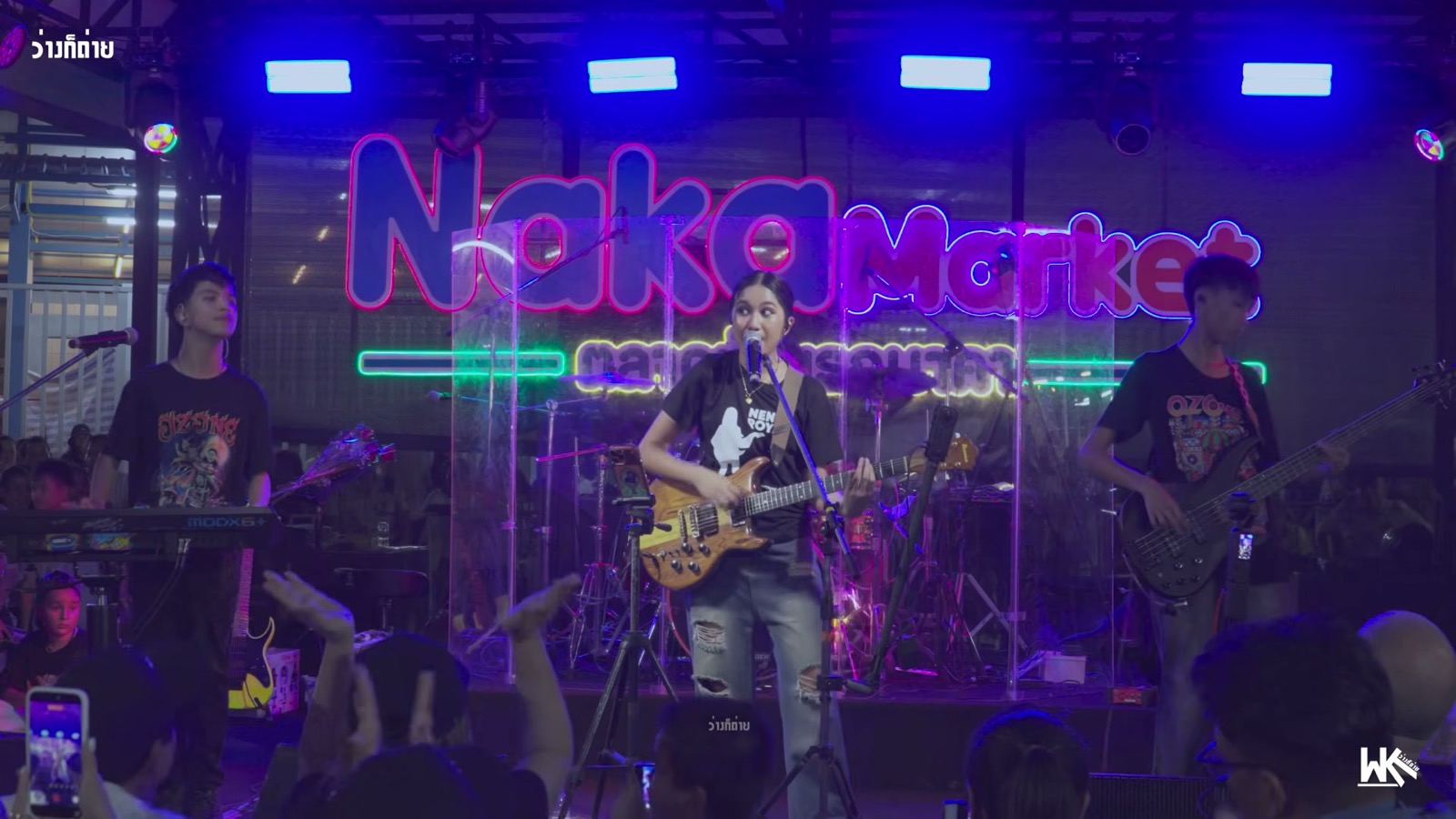
Her AGT arc itself moved fast by TV standards, slow by hers: she auditioned on July 7, 2026, with a cover of The Cranberries' "Zombie" that earned four yeses and reportedly became the most-viewed audition of the season within its first day online. Judges' Callbacks followed August 8–11 with Muse's "Hysteria." Then the Live Quarterfinal on August 25, and the Golden Buzzer. Every stage of that arc was new to American television audiences. None of it was new to her.

Is Nene Royal an industry plant?
The question is worth answering directly instead of dodging, because it's exactly what a chunk of the search traffic to this article is looking for. "Industry plant" originated on hip-hop message boards in the early 2010s and later got applied broadly to artists like Clairo and Billie Eilish, usually as an accusation that a seemingly organic rise was secretly manufactured by label money or connections. It's also a term that critics have pointed out lands disproportionately on women, often with thin evidence behind it.
There's no evidence of anything like that here. Nothing in this piece claims AGT is scripted, that Mel B was told what to do, or that NBC predetermined a result, those would be serious claims, and none of the reporting or public record supports them. What actually happened is closer to cross-market talent arbitrage: a genuinely accomplished regional performer, with a real fanbase and a documented multi-year track record, got picked up by a distribution system with a global reach she didn't have on her own. That's not a plant. It's closer to what a record label calls "already de-risked": a bet on someone who has already proven the hard part.
Engineering the inputs without faking the outcome
This is the part that generalizes, and it's worth being precise about it. AGT's casting process, like most large TV competitions, runs producers' auditions and casting-producer scouting for months before anyone is seen by a judge: a substantial share of televised acts are identified and vetted well in advance. That's a real, documented part of how the show works, and it's a completely different thing from rigging who wins.
Controlling the shortlist isn't the same as controlling the outcome. A venture firm that only meets founders through warm introductions hasn't fixed which startup succeeds: it's just improved the average quality of what reaches its table. A talent agency that's selective about whose reel gets sent out hasn't decided who lands the role: it's decided who gets a fair shot at being considered. AGT's casting team, by putting a proven, camera-ready act like Nene Royal in front of judges in the first place, improved the odds of a strong moment without needing to touch what happened once she was standing there. The engineering happens upstream, in who gets a shot. The outcome still has to be earned in the room.

She isn't just talent. She comes with distribution attached.
Multiple outlets, including the Bangkok Post, report Nene Royal's combined social following at more than three million, with at least one source putting her TikTok following alone at roughly 1.8 million. The exact number moves depending on which platforms get counted and when: that variance is real and worth naming rather than smoothing over. But the scale isn't in question, and the scale is the point.
An AGT clip of an unknown act has to build its own audience from the show's promotion alone. A clip of Nene Royal starts with a running head start: her own following reshares it, reacts to it, and pushes it into algorithmic feeds that a first-time act's clip never touches. Same production cost to the network, higher expected reach: because part of the audience was already primed to watch and share before the clip existed. That's what "distribution attached" actually means in practical terms: not that she's famous, but that promoting her content doesn't start at zero.
Social proof isn't economic value, and that gap is the point
It's worth being honest about a distinction that gets blurred whenever a "millions of followers" number gets waved around: a view is not a dollar. Advertising CPMs vary enormously by geography: broadly, Tier 1 markets like the US, UK, Canada, and Australia run somewhere around $7–13 per thousand views blended across platforms, Tier 2 markets like Western Europe and the Gulf states run roughly $4–7, and Tier 3 markets across South and Southeast Asia typically land around $1–3. YouTube specifically has shown gaps of 30 to 50 times between its highest- and lowest-paying markets for otherwise identical content.
That means a view is one thing on the public counter and a genuinely different thing in an advertiser's ledger. A million views split heavily across Thai and Southeast Asian audiences and a million views split heavily across US audiences look identical on a follower count: they are not identical as monetizable reach. That gap doesn't make the audience less real. It means audience size and audience monetization are two separate questions, and treating them as one is exactly the kind of mistake that makes an otherwise sound creator deal or partnership underperform financially even when the reach numbers were completely accurate.
A rock catalog and a demographic bridge
There's a real, if easy to overstate, mechanic in what she's chosen to cover: Soundgarden, Muse, The Cranberries: catalog rock, largely from acts whose core audience skews older and whose association with a competition-show teenager is not the obvious pairing. It would be lazy to reduce this to some tidy political mapping of who likes rock versus who likes an international teenage performer, and this piece isn't making that argument. What's actually happening is narrower and more useful: the same performance is legible to two audiences with genuinely different expectations at once: listeners who came for a catalog they already love performed with real technical skill, and viewers drawn to the discovery, youth, and international angle of the story. Neither audience has to change what it already likes for the bet to work for both of them simultaneously.
The Thailand advantage: one event, two true stories
The same August 25 clip is, right now, generating two different true narratives in two different markets, and neither one needs the other to be wrong. In the US, it's read as a discovery story: an unknown talent breaking through on a competition stage. In Thailand, Prime Minister Anutin Charnvirakul and members of his cabinet hosted her at Government House, the government named her a tourism-promotion figure, and reporting from the Bangkok Post and The Thaiger indicates AGT-related costs were covered, turning the same clip into a national-pride story with institutional backing behind it.
That's the concept worth naming here: audience arbitrage, at the market level. The same underlying asset (her performance, her story) gets narrated completely differently for two audiences that never have to reconcile their two versions of the story with each other, and both versions make the asset more valuable, not less. To be clear about what this isn't: there's no evidence the Thai government influenced AGT's outcome, and this piece isn't claiming that. What's notable is the pre-existing institutional backing and infrastructure behind her: evidence she arrived with real support, not evidence anyone rigged a competition on the other side of the world.
Audience arbitrage, beyond one guitarist
The underlying pattern generalizes well past a talent show, and it's worth naming plainly: don't manufacture demand if you can import it. Whenever a business has to choose who or what to bet on, it faces some version of the same decision AGT's casting team faced: build an audience for something new, or find someone who already has one and add distribution. The same logic shows up in:
- Creator and influencer partnerships: a brand backing a creator with an existing, engaged following instead of building an audience for a new face from scratch.
- Startup founder selection: investors and accelerators favoring founders who already have a community, a distribution channel, or a prior audience behind their idea.
- Brand ambassador and casting decisions: choosing a face that already carries recognition and trust with the target audience, rather than introducing an unknown one.
- Sports recruiting: a program or league valuing a recruit's existing fanbase and following alongside pure athletic performance.
- Podcast and media guest booking: a guest who brings their own audience delivers a different return than one who doesn't, independent of how good the conversation is.
- Acquisitions: buying a company partly for its existing user base and distribution, not only its product or technology.
- Geographic market expansion: entering a market where the target audience already has awareness of the brand through another channel, rather than building awareness cold.
None of this required AGT to be rigged, Mel B to be told what to do, or Nene Royal to be anything other than a genuinely skilled 16-year-old who has been performing in public since she was eight. It only required a production system that's good at recognizing where the inputs were already stacked in one direction, and a business lesson that applies just as well the next time anyone is deciding who to bet on.
For what it's worth, here's where I'd put my own chips.
Research Confidence
This article is based on:
- Evidence: the August 25, 2026 Golden Buzzer event, Mel B and Howie Mandel's on-air statements, and the September 22–23 finale dates are corroborated across TVInsider, the Bangkok Post, Nation Thailand, Parade, and Cinemablend
- Evidence: Nene Royal's biography, busking history, competition record, and combined social-following figure (reported as "more than three million") are drawn from named outlets including Wikipedia, the South China Morning Post, the Bangkok Post, and IBTimes Singapore, with platform-count variance flagged rather than smoothed over
- Heuristic: the CPM/geography figures, the casting-mechanics argument, and the "engineering inputs vs. faking outcomes" framing are Design Delulu's own reasoned synthesis, built on documented industry patterns and public CPM benchmark ranges rather than a single cited study
- Hypothesis: the August 26, 2026 prediction that Nene Royal wins Season 21 is explicitly forward-looking and unproven until the finale airs
Confidence Level: Normal
FAQ
Is Nene Royal an industry plant?
There's no evidence of coordinated deception, and the term is a poor fit here. Her performing history (busking at Phuket's Naka Weekend Market since about age eight, band credits with OZONE Band and Miniheart, named competition results dating back to 2022) is independently documentable years before AGT ever saw her. The more accurate description is cross-market talent arbitrage: an artist who built a real regional following got discovered by a bigger distribution system, not manufactured by one.
Did Mel B know she'd hit the Golden Buzzer, or was the moment staged?
No evidence supports that, and this article doesn't claim it. Golden Buzzers are real, in-the-moment judge decisions. What is true and well-documented is that AGT's casting process (producers' auditions, casting-producer scouting) pre-identifies and vets acts long before they reach the judges' table. That's a normal production practice, and a separate thing entirely from rigging who wins.
What is "audience arbitrage"?
Audience arbitrage is choosing a person, product, or partner who already arrives with product, story, audience, distribution, and social proof attached, rather than manufacturing demand for something new from zero. The bet shifts from "can we create attention" to "can we point a bigger distribution system at attention that already exists."
Will Nene Royal actually win AGT Season 21?
Nobody can know that yet: the two-part finale airs September 22–23, 2026. This article includes a dated, public prediction, made August 26, 2026, that she wins. It's offered as a business and marketing call based on her asset profile, not as inside information, and it's explicitly falsifiable against the actual result.
What does a Thai teenager's talent show run have to do with business strategy?
Every business making a bet on a person or partner (a creator deal, a hire, a brand ambassador, a market-entry choice) faces the same underlying decision AGT's casting team faces: build demand from nothing, or find someone who already has it and add distribution. Nene Royal's case just makes that choice visible and dated.
Ready to turn attention into customers?
Book a free discovery call and let's map your growth system.
Free Marketing Audit Or book a strategy call