
The Delulu Blog
Why most business content fails to create customers

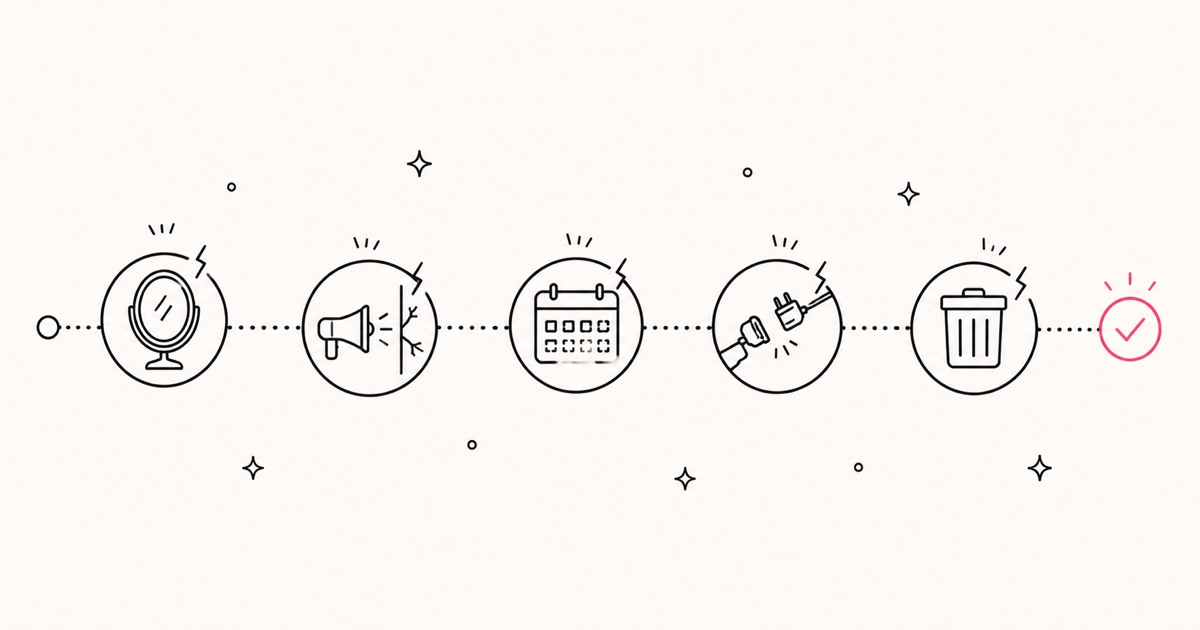
Most business content fails. Not because it's ugly, and not because the algorithm is out to get you. It fails because it was never designed to succeed at anything specific in the first place.
Here are the real reasons content doesn't create customers, and what to do about each one.
1. It was made for the business, not the customer
'We're excited to announce…': nobody is excited with you yet. Content that talks about your business instead of your customer's problems gets scrolled past, because attention follows self-interest.
Here's what this looks like in practice: a post that opens with a company milestone, a new hire, or an award. Genuinely nice things to celebrate internally, but a stranger scrolling their feed has no reason to stop for them, because none of it answers 'what's in this for me.' The fix: lead with the customer's question, pain, or goal. Your business shows up as the answer, not the headline. 'Here's why your invoices keep getting paid late' stops a scroll. 'We're thrilled to announce our new office' doesn't, even if it's true and worth celebrating internally.
2. It chases attention and stops there
A viral post is fun. We genuinely love making them. But attention is the first step of four: Attention → Trust → Leads → Customers, and most content strategies quit after step one. Views without a path to trust and action are entertainment, not marketing.
This is the trap that catches ambitious businesses specifically, because a big view count feels like proof something is working. It's proof something was watched. Whether it moved anyone toward becoming a customer is a completely separate question, and most businesses never actually check. The fix: every piece of content should hand the viewer a next step, even a small one: a question to answer in the comments, a link to a deeper resource, an invitation to follow for the rest of the story.
3. It's inconsistent
Trust is built by showing up repeatedly. Eleven posts in January and silence until April doesn't read as 'busy' to your audience: it reads as 'maybe out of business.' Consistency beats brilliance in small business content, and it's not close.
The businesses that get this wrong usually aren't lazy: they're relying on inspiration and spare time, both of which vanish exactly when the business gets busy (which is, unhelpfully, also when marketing matters most). The fix: a sustainable cadence you can actually maintain, protected by a system rather than willpower. Two solid posts a week, every week, for a year outperforms a burst of twenty posts followed by three months of silence, every time.
4. It has no connection to revenue
If you can't explain how a piece of content moves someone closer to becoming a customer, it's decoration. That doesn't mean every post screams 'BUY NOW': trust-building content is doing revenue work too. It means every post has a job: get seen, build credibility, capture interest, or convert.
Most businesses without a system can't answer a simple question: 'which of our last ten posts was meant to generate a lead, and did it?' Not because the content was bad, but because nobody decided its job before it was made. The fix: assign the job before you make the content, not after. A five-second decision at the planning stage saves hours of guessing at the review stage.
5. It's one-and-done
Most businesses extract about 10% of the value from the content they create. A great video should also become clips, quote graphics, a blog post, and an email. Instead, it gets posted once, performs however it performs, and disappears into the feed forever.
This is the most purely wasteful failure pattern on this list, because the hard part (having the idea, doing the shoot, writing the draft) is already done by the time the content dies of neglect. The fix: repurposing isn't recycling; it's how small teams compete with big budgets. One good idea, treated properly, is a week of content instead of one post.
How to audit your last ten posts in fifteen minutes
Theory is nice; your actual feed is nicer. Pull up the last ten things your business published, any channel, and score each one against four questions:
- Who was it for? If the honest answer is 'us,' mark it down. Customer-first content names a problem, a question, or a goal your customer recognizes in the first line.
- What was its job? Attention, trust, lead capture, or conversion. 'It was Tuesday and we hadn't posted' is not a job.
- What was the next step? Even trust content can point somewhere: read this, save this, reply with this, book this. No next step means the journey ended on purpose.
- Did it get reused? If a strong post lived once and died, you paid full price for a tenth of the value.
Most businesses score under 50% on this audit the first time, and that's genuinely fine: you can't fix a pattern you haven't seen. The audit isn't there to make you feel bad about old posts. It's there to change the question you ask before the next one: not 'what should we post?' but 'what job needs doing this week?'
Run the same audit again in 60 days. The score moving is the system working.
| Failure pattern | What it usually means | Fix |
|---|---|---|
| Made for the business | The content leads with internal news | Lead with the customer problem |
| Chases attention | Views are treated as the outcome | Add trust and next-step paths |
| Inconsistent | Output depends on spare time | Build a sustainable cadence |
| No revenue connection | No job is assigned before publishing | Define seen, trusted, captured, or converted |
| One-and-done | Strong ideas are used once | Repurpose into multiple assets |
What to do this week
You don't need a six-month transformation plan to start fixing this. This week: pick the one channel where your customers actually spend time, and commit to a cadence you could keep up on your worst week, not your best one. Write down the four content jobs (seen, trusted, captured, converted) and assign one to everything you make before you make it. Take your single best-performing piece from the last three months and turn it into three more assets. And add one clear next step to every post that currently ends in a dead end. Small moves, but every one of them attacks a failure pattern directly, and together they're the skeleton of a system.
The pattern behind all five
Every one of these failures is a missing system, not a missing talent. Businesses don't fail at content because they're not creative enough. They fail because nothing connects the content to the customer. Connect those dots: deliberately, repeatedly, and content stops being a chore and starts being an engine.
Research Confidence
This article is based on:
- Direct observations from content audits and conversion-path reviews
- Multiple small business failure patterns across social, website, and follow-up workflows
- Platform behavior patterns around attention, engagement, and off-platform action
- Hypotheses still being tested around which content failure points are fastest to fix first
Confidence Level: High
FAQ
How often should a small business post content?
Whatever cadence you can sustain for six months straight. Consistency at three posts a week beats bursts of daily posting followed by silence.
Do viral posts help a small business?
They can spike attention, but attention only converts when trust and a clear next step are already in place. Treat virality as a bonus, not a plan.
What's the biggest content mistake small businesses make?
Talking about themselves instead of the customer's problem. Attention follows self-interest: lead with what your customer wants to solve.
Should every post try to sell something?
No. Most content should build trust and visibility. But every piece needs a defined job: seen, trusted, captured, or converted.
How do I repurpose content effectively?
Start with one strong idea, usually video. Cut clips, pull quotes into graphics, expand the idea into an article, and send the best version by email.
Ready to turn attention into customers?
Book a free discovery call and let's map your growth system.
Free Marketing Audit Or book a strategy call