
The Delulu Blog
Tools generate content. Systems generate results.

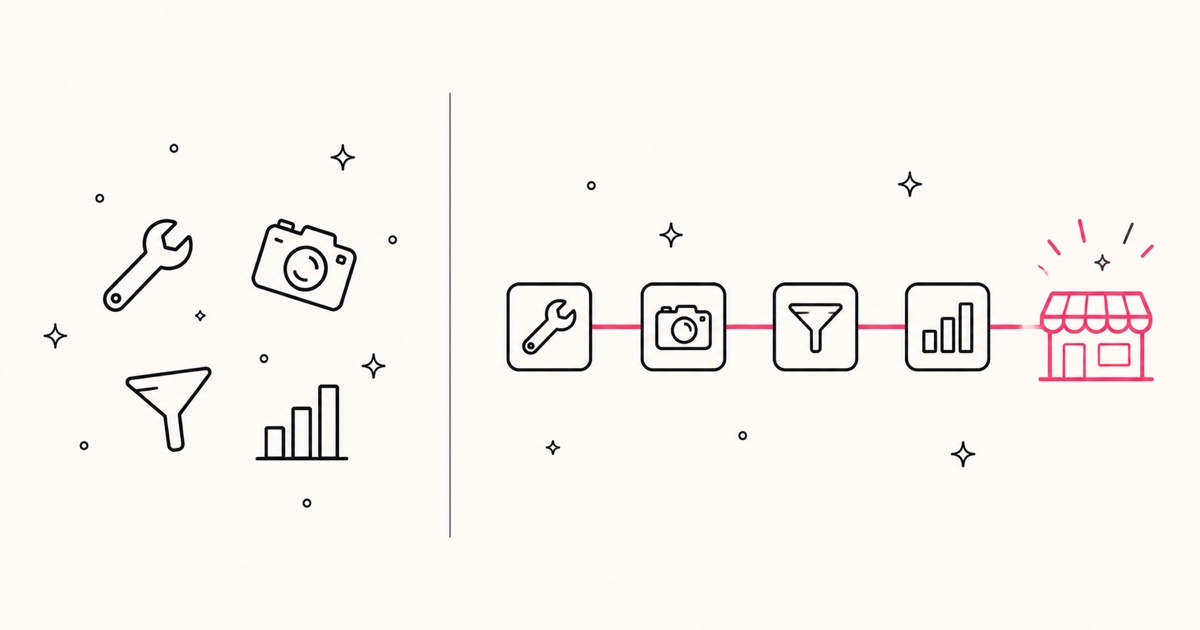
Every week, a small business owner somewhere signs up for a new tool that promises to fix their marketing. A scheduler. An AI writer. A template pack. A 'growth hack' course. And every week, the same thing happens: a burst of activity, a slow fade, and a credit card statement that's the only consistent thing about the whole operation.
Here's the uncomfortable truth: tools generate content. Systems generate results. They are not the same thing, and confusing them is the most expensive mistake in small business marketing.
Tools answer 'how.' Systems answer 'why' and 'what for.'
A tool helps you produce a thing: a post, a video, a graphic. That's genuinely useful. But a tool has no opinion about whether that thing should exist, who it's for, or what it's supposed to accomplish. It will happily help you produce content nobody needs, faster than ever.
A system, on the other hand, starts with the destination. In our world, that destination is always the same: Attention → Trust → Leads → Customers. A system decides what content gets made, where it goes, how it connects, and how one piece feeds the next. The tools just execute.
Think of it like a kitchen. A knife, a stove, and a mixer are tools: genuinely necessary, completely inert on their own. A recipe, a prep list, and a plating standard are the system. Buy the fanciest knife on the market and you still don't have dinner. The tools don't decide what gets cooked; the system does.
Why 'more tools' feels productive but isn't
Buying a tool feels like progress because something happened. You took action. But activity and progress are different metrics:
- Activity: we posted 14 times this month.
- Progress: we generated 9 qualified leads this month.
Tools are great at increasing activity. Only systems reliably increase progress, because only systems connect content to a business outcome. Without that connection, more output just means more noise, yours, added to everyone else's.
This is why 'we're posting more than ever and nothing's changing' is one of the most common things we hear from a business before they build a real system. More activity without a system doesn't compound: it just repeats.
What a content system actually looks like
A real content system (what we call a Results-Driven Content Engine) has a few non-negotiable parts. Here's what each one actually does, not just what it's called:
- A strategy rooted in your business, your customers, and what actually makes you money. In practice, this means every content decision traces back to a specific answer to 'who is this for, and what do we want them to do next', not a vague sense that 'we should probably post more.'
- A repeatable production process so content ships consistently, not when inspiration strikes. This is usually the single biggest gap in businesses without a system: production depends on one person's energy and calendar, which means it stops the moment that person gets busy, which is often exactly when marketing matters most.
- Repurposing built in: one strong idea becomes a video, three posts, a graphic, and an article. Most businesses create once and use once. A system treats every strong idea as raw material for five to ten pieces of content, which is the difference between a small team and a small team that outputs like a bigger one.
- A calendar so there's never a 'what do we post today?' panic. Not a content idea graveyard: an actual schedule where the next two to four weeks are already decided before the week starts.
- A feedback loop: watch what works, do more of it, kill what doesn't. Without this, a system just repeats its own mistakes on a schedule instead of randomly. The loop is what makes a system get better over time instead of just staying consistent.
Notice that tools appear nowhere in that list as the point. Tools serve the system. The moment the tool becomes the strategy, you've bought a very expensive way to stay inconsistent.
What this looks like in practice
Business A: tool stack
- owns a scheduler, AI writer, and stock photo subscription
- plans content at the last minute
- publishes when the owner has spare time
- starts from zero every week
Business B: content system
- uses the same tools inside a monthly plan
- starts with business themes and customer questions
- turns one idea into several assets
- reviews what produced attention, trust, and leads
Picture two businesses selling the same service, both posting content, both using similar tools. Business A bought a scheduler, a caption-writing AI tool, and a stock photo subscription. Every Sunday night, the owner scrambles to figure out what to post that week, drafts something quickly, schedules it, and moves on. Some weeks nothing gets posted at all.
Business B has the exact same tools. The difference is what happens before the tools get touched: a monthly plan decides the themes, one strong idea gets filmed or written each week, and that single idea gets reworked into three or four different pieces across channels. The scheduler just loads what the system already decided.
Same tools. Same budget, roughly. Completely different output, because one business has a system deciding what the tools should do, and the other is using tools to decide what to do at all.
The hidden cost of tool-stacking
The subscription fees are the visible cost, and honestly, they're the small one. The real costs hide in three places. First, switching time: every new tool needs setup, learning, and migration, which is a week of your attention that produced zero marketing. Second, fragmentation: your captions live in one app, your videos in another, your calendar in a third, and nothing talks to anything, so nothing compounds. Third, and most expensive, the illusion of coverage: owning a scheduler feels like having a social strategy, the way owning running shoes feels like training for a marathon.
Meanwhile, the businesses winning your market are usually running fewer tools than you are. They just run them inside a system, on a schedule, pointed at a goal. Boring? A little. Effective? Extremely.
A 30-day test: do you have a system or a stack?
Here's a simple way to find out which one you actually own. For the next 30 days, answer these four questions honestly:
- Can you say, right now, what's being published next Tuesday? A system knows. A stack shrugs.
- Does each piece of content have a defined job (seen, trusted, captured, or converted) before it's made?
- Did at least one strong idea become three or more assets through repurposing?
- Can you connect this month's content to a business number (inquiries, calls, leads) without squinting?
Four yeses means you have a system; protect it. Two or fewer means you have a stack: an expensive collection of capabilities with no engine connecting them. The good news: the gap between a stack and a system isn't money. It's structure. You likely already own every tool you need.
Where AI fits in all of this
AI is the most powerful content tool ever built, and it's still just a tool. Used inside a system, it's a force multiplier: faster production, cheaper repurposing, more consistent output. Used without one, it's the fastest noise generator ever invented. The businesses getting real results from AI aren't the ones with the cleverest prompts; they're the ones whose system tells the AI exactly what job each piece of content has to do. Same tool, completely different outcome: the difference is the engine around it.
This matters more now than it did two years ago, because AI has made production nearly free. When production was expensive and slow, the bottleneck was naturally the tool. Now that anyone can generate content in seconds, the bottleneck has fully shifted to strategy: deciding what's worth making at all. Businesses that haven't noticed this shift are drowning in AI-generated content that changes nothing about their pipeline.
The takeaway
Before you buy the next tool, ask one question: what system is this tool serving? If you don't have an answer, the tool isn't your problem: the missing system is. Build the system first. The tools get a lot cheaper and a lot more useful after that.
Research Confidence
This article is based on:
- Direct observations from content workflow and automation planning
- Multiple small business patterns where tools increased output without improving outcomes
- Platform and software behavior patterns around publishing, scheduling, and AI-assisted production
- Hypotheses still being tested around which parts of a content system should be automated first
Confidence Level: Normal
FAQ
Do I still need marketing tools if I have a system?
Yes: tools execute the system. A scheduler, editor, or AI assistant is useful once a strategy decides what gets made, for whom, and why.
What's the first step in building a content system?
Start with your business goal, not a content format. Define who your customer is and what action you want, then work backward to channels and content types.
How many channels should a small business be on?
Fewer than you think. One or two done consistently beats five done sporadically. Expand only after the system runs reliably.
Can AI tools replace a content strategy?
No. AI speeds up production, but it can't decide what your business needs or judge what builds trust with your specific customers. Strategy stays human.
How do I know if my content is working?
Track business outcomes, not vanity metrics: inquiries, calls booked, leads captured, and customers won, then compare month over month.
Ready to turn attention into customers?
Book a free discovery call and let's map your growth system.
Free Marketing Audit Or book a strategy call