
The Delulu Blog
I Built MultiStream.cc To Watch Twitch, Kick, YouTube & TikTok LIVE

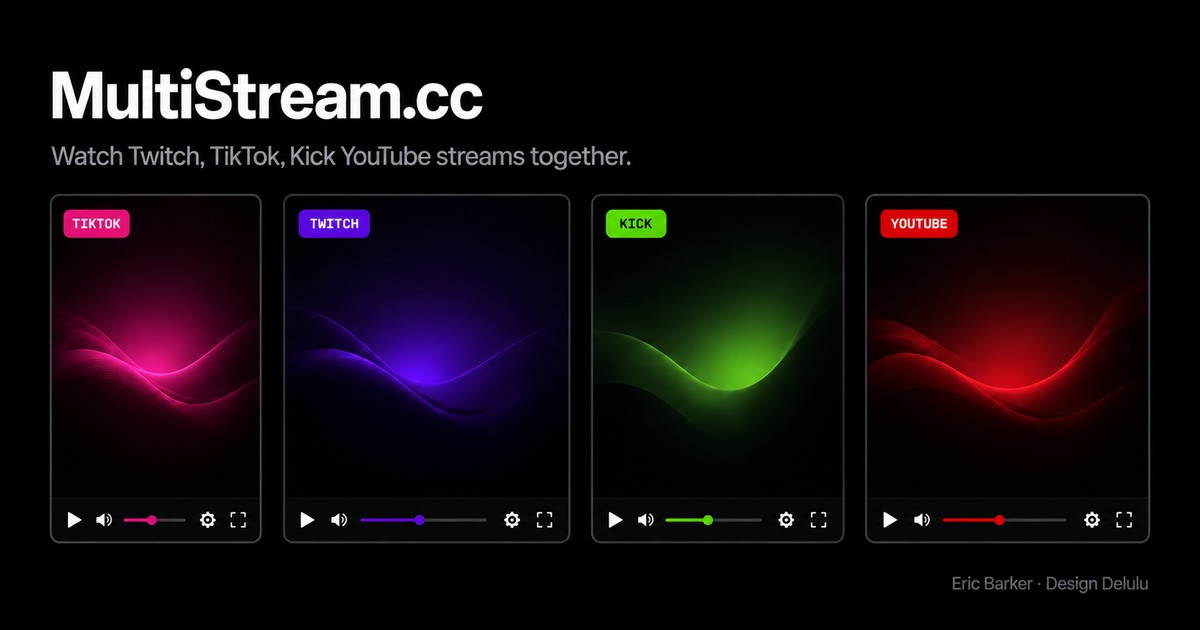
I know multistream viewers already exist. I tried them. Most felt cluttered, awkward, or arranged streams in a way that never matched how I personally watch Twitch and Kick.
So I stopped looking for the perfect one and built MultiStream.cc around my own habits. I’ve ended up using it every day.
Watch Twitch, Kick, YouTube, and TikTok LIVE streams online on one page
That’s the job: open a browser, add channels or videos, and watch Twitch, Kick, YouTube, and experimental TikTok LIVE together without juggling tabs or resizing windows. MultiStream.cc packs official player embeds (plus a resolver-backed TikTok LIVE player marked Experimental on every card) into a responsive grid: 16:9 for landscape streams, 9:16 for portrait Shorts and TikTok LIVE. Free, no account. The rest of this post is why I built it this way and how I use it day to day.
I scratched my own itch
This wasn’t supposed to be a startup pitch. Most of the things I build are experiments. This one unexpectedly became something I open every time I want to follow a co-stream, a tournament weekend, or a few channels at once without rearranging a pile of browser windows.
The existing tools weren’t broken. They just weren’t designed for how I watch. I kept thinking, “I wish this worked differently”: less chrome, fewer decisions, a layout that stays out of the way, Twitch and Kick on the same page without fighting the UI. Eventually the gap between “almost right” and “right for me” was big enough to build.
I’m not claiming I invented the first multistream viewer. I’m saying I built the one I wanted to use.
A modern multistream viewer, on purpose
MultiStream.cc isn’t trying to support every possible workflow. It’s a modern multistream viewer based on how I actually watch livestreams: clean layout, minimal controls, quick stream switching, and as little friction as possible.
That framing matters. Limitations aren’t apologies: they’re design choices. I cared about these things first:
- Simple username field: type a name (or
@name), pick Twitch, Kick, YouTube, or TikTok LIVE (Experimental) from the dropdown, or paste any supported link. Press Enter to reuse your last platform. - Twitch + Kick + YouTube + experimental TikTok LIVE: the first three via official embeds; TikTok LIVE via a resolver and
<video>player, all on one page, packed at the largest size that fits (16:9 landscape, 9:16 portrait). - On-card headers: platform badge + username on every stream so you can tell who’s who without leaving the viewing plane. That’s my default.
- Hide headers toggle: collapse the top bars for a denser grid; at rest you see video only, and hovering a card opens a control strip below the embed (name, drag, focus, remove). Preference is remembered.
- Focus mode: expand one stream, unmute it, and open Twitch chat when available.
- Drag reorder: drag card headers, or the drag handle in the hover toolbar when headers are hidden. Playback keeps going.
- Focus View: a toolbar toggle that swaps the whole layout to one large primary stream and a tray of the rest; click a tray stream's header to promote it, nothing reloads. Different from Focus mode above: Focus View changes the whole page's layout, Focus mode expands just one card.
- Portrait streams keep their shape: a YouTube Short or TikTok LIVE stream gets a fixed 2-row-tall slot in the grid instead of a squeezed partial row, and stays letterboxed to its real 9:16 instead of being stretched.
- Twitch chat, Share, Clear: toolbar toggles and icons; Share copies a static watch URL, starts a Live Watch Party, or generates a Story Card when you need it. No account required.
- Live Watch Party: share one link at
/w/ROOM_ID; viewers follow your lineup automatically when you add, remove, replace, or reorder streams. Copy Watch URL is different: a fixed snapshot that does not change.
Performance still depends on how many live embeds you open: each stream is a full platform player. Fewer streams means smoother playback, especially on laptops and phones. That’s a platform constraint, not something a wrapper can magically fix.
How I actually use it
Day to day starts at the input field. Click it, type a channel name, choose Twitch, Kick, YouTube, or TikTok LIVE (Experimental) from the dropdown: done. Leading @ gets stripped. Paste a channel URL if you already have one. For YouTube I drop in a video link, a youtu.be link, a live or Shorts URL, a channel handle like @creator, a channel URL, or a channel ID: a direct video link loads that video, and a channel adds whatever it’s currently live-streaming, or tells me plainly if it isn’t live rather than loading some old upload. For TikTok LIVE I pick it from the dropdown, paste a tiktok.com/@creator/live URL, or drop in a mobile share link: each card is marked Experimental, and the player resolves through a small backend script rather than an official embed. Each stream lands in the grid with focus and remove controls. Everything boots muted (browsers block unmuted autoplay); I unmute with focus when I want sound fast.
My preferred mode is headers on. When you’re watching four or five streams, the top bar on each card is what keeps identity attached to the picture: purple for Twitch, green accents for Kick, username right there, and a small Experimental tag on TikTok cards. I don’t want extra chrome covering the video: the header on each card is enough when I’m following several streams.
Some people hate that chrome. Fair. Hit Hide headers and you get a denser viewing experience: just the players at rest. Hover any card and a slim toolbar opens below the video with the channel name, a drag handle, focus, and remove. Nothing sits on top of the embed; Twitch’s embed rules and Chrome’s visibility checks made that non‑negotiable. The toggle sticks in local storage, so you set it once and keep your preference.
From there the rest of the toolbar is light: Twitch chat docks beside the grid on desktop and tablet (and resizes players instead of covering them, covering would pause Twitch embeds). The Share menu copies a static watch URL, starts a Live Watch Party, or generates a Story Card when you want to invite someone. Clear all wipes the board when you want a fresh start. On phones, chat hides and streams stack in a single column.
Share what you’re watching: including live watch parties
MultiStream started as “put several streams on one screen.” Sharing made that useful: Copy Watch URL gives someone a fixed snapshot of your lineup. Live Watch Party is the step beyond that: share one link once, and when you change what’s in your session, their session follows.
Instead of texting a new Twitch or Kick link every time you switch channels, send the watch-party link. Keep watching normally. Add a stream, drop one, reorder the grid: everyone in the room gets the update automatically. Viewers who join late land on whatever you’re watching right now, not a stale snapshot.
MultiStream doesn’t rebroadcast the video. Each person still loads the actual stream from Twitch, Kick, YouTube, or TikTok. What’s shared is the lineup: which streams are open and in what order, not synchronized playback down to the frame.
Not finished. Already useful.
MultiStream.cc is still a work in progress. I’m not pretending otherwise. It launched with Twitch and Kick; YouTube joined them; experimental TikTok LIVE is the latest addition; Live Watch Parties are the latest capability: so now you can mix live streams and videos from all four in the same grid, share a fixed lineup, or host a live room where viewers follow your changes. The current version already replaced the other multistream viewers I was using: which is the only bar that mattered for shipping it.
Under the hood it’s vanilla TypeScript and Vite: no React, no user database. Twitch and Kick are plain iframe embeds; YouTube channel lookup and TikTok LIVE playback each hit a small PHP script on the same host; optional Twitch/Kick status metadata uses the same pattern. Each platform is a small adapter file registered in a shared grid and state layer. The project sits in Design Delulu Labs as an open side project, not a feature factory.
If you want to inspect the embed notes, device matrix, or deployment steps, it’s MIT-licensed at github.com/designdelulu/multistream.
And if your watching habits match mine, or you’re tired of rearranging windows every tournament weekend: try it. Start a watch party, share the link, and keep switching streams without sending new URLs. If they don’t, the other viewers are still there.
Research Confidence
This article is based on:
- Personal, daily use of MultiStream.cc while watching Twitch, Kick, YouTube, and experimental TikTok LIVE side by side
- Direct design and implementation of MultiStream.cc (Design Delulu Labs), including the username dropdown, header vs. hide-headers toolbar modes, focus, toolbar toggles, YouTube link/handle/channel resolution, experimental TikTok LIVE support, and Live Watch Party lineup synchronization documented in the product user guide
- Twitch, Kick, and YouTube official embed/API documentation; observed TikTok LIVE resolver behavior; player behavior across desktop, tablet, and phone layouts
- Prior art in the category (including tools like MultiTwitch) as context that multistream viewers already existed; this project is a modern alternative, not a claim of first
Confidence Level: Experimental
FAQ
Why build another multistream viewer if plenty already exist?
Not because they don’t exist: because the ones I tried didn’t match how I like to watch streams. MultiStream.cc is a modern multistream viewer built around my own habits: clean layout, minimal controls, Twitch, Kick, YouTube, and experimental TikTok LIVE together, and as little friction as possible.
Can I watch Twitch, Kick, YouTube, and TikTok LIVE together?
Yes. MultiStream.cc lets you watch Twitch, Kick, YouTube, and experimental TikTok LIVE together on one page in a free browser viewer, no account required. Pick any platform from the dropdown, or paste a Twitch/Kick username, a YouTube video/live/Shorts link or channel handle, or a TikTok LIVE URL such as tiktok.com/@creator/live. Keep headers on to see who’s who, or hide them for a denser grid.
Is MultiStream.cc free to use?
Yes. MultiStream.cc is free, runs in your browser, and requires no account. Type a username and pick Twitch, Kick, YouTube, or TikTok LIVE from the dropdown, or paste a supported URL: then use the Share menu to copy a static watch URL or start a Live Watch Party.
What is a Live Watch Party?
A Live Watch Party is a live session at multistream.cc/w/ROOM_ID. Share the link once; viewers see your current lineup and it updates automatically when you add, remove, replace, or reorder streams. MultiStream synchronizes the lineup, not the video: each viewer still loads streams directly from Twitch, Kick, YouTube, or TikTok. Copy Watch URL is different: that is a fixed snapshot that does not change.
What’s the Hide headers toggle for?
By default, each stream card shows a top bar with the platform badge and username so you can tell who’s on at a glance. Hide headers collapses those bars for a denser grid. At rest you see video only; hover a card and a toolbar appears below the player for focus, remove, and drag reorder: controls never cover the embed. The preference is remembered. I leave headers on; people who want less chrome can turn them off.
Is MultiStream.cc finished?
No: it’s still a work in progress. The current version is already useful enough that it replaced the other multistream viewers I was using day to day. Open source under MIT if you want to inspect how it works.
Built for yourself first, then for customers?
That’s the same discipline behind our client work: modern systems that solve a real job, not feature sprawl. Start with a free Marketing Audit and we’ll map what actually moves your business.
Free Marketing Audit Or book a strategy call