
The Delulu Blog
AI Agents for Small Business: From Chatbots to a Digital Workforce

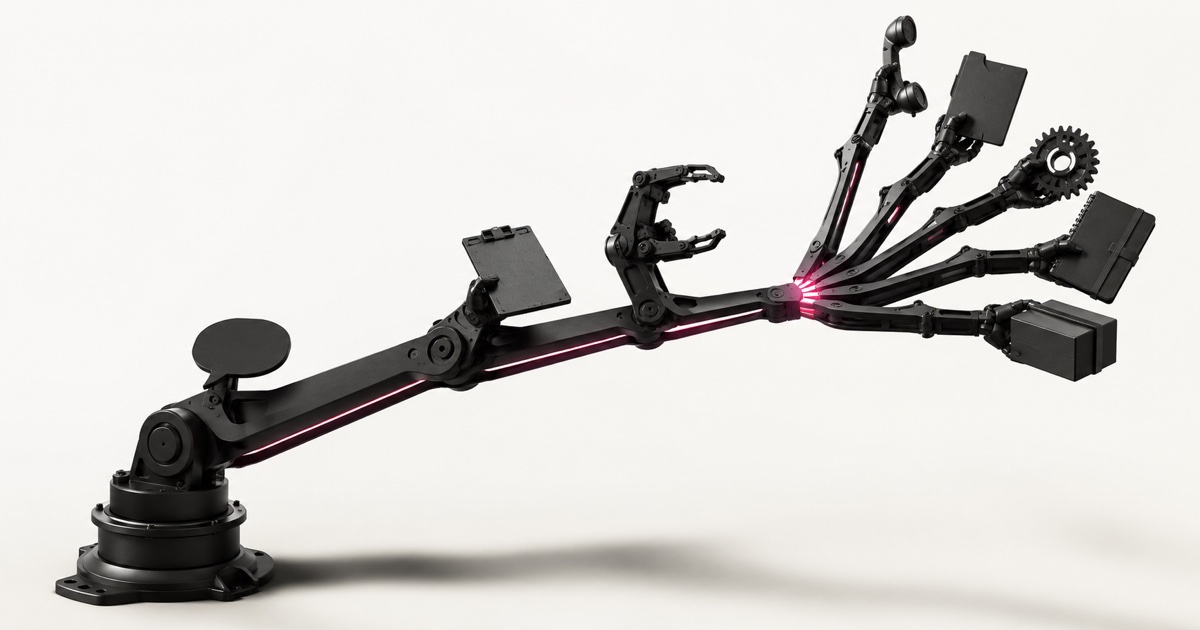
You probably already have three different "AI agents."
A chat widget on your website that answers hours-and-pricing questions. A Copilot-style tool drafting your emails. Maybe one Zap that fires automatically when a form comes in. You've been calling all three "AI", but they're not the same thing, and the gap between them is exactly what this article maps.
Why "AI agent" stopped meaning one thing
Vendors sell a $20/month chat widget and a system that claims to run a whole business function under the identical word: "agent." Nobody selling either one has much incentive to clarify which they actually mean, because "agent" now carries more marketing weight than any of the words it replaced (chatbot, bot, automation, assistant). That's not a small-business problem specifically: it's an industry-wide framing problem, but it lands hardest on small-business buyers, who don't have a procurement team to translate vendor language into an actual capability list before they sign up.
There are five genuinely different things happening under that one word. Naming them precisely is the whole point of this article.
| Stage | What it means | Real 2026 example |
|---|---|---|
| 1. Chatbot | Reactive: answers questions, takes no action | Website FAQ/support widgets |
| 2. Copilot | Drafts, summarizes, recommends: a human approves every output | Email and content drafting assistants |
| 3. Workflow automation | Executes a fixed sequence, no human approving each step | Zapier's rule-based Zaps |
| 4. Task-specific agent | Given a goal, decides its own steps for one bounded task | Salesforce's free Agentforce Employee Agent (SMB tiers) |
| 5. Coordinated multi-agent system | Multiple agents run a function together, human sets direction | Design Delulu's Content Engine™ + Growth Intelligence stack |
The five stages, one at a time
Stage 1: Chatbot. Reactive. It answers a question when asked and takes no action on its own. This is most of what small businesses mean when they say "we have AI on the website": a widget that deflects simple, repetitive questions away from a human. Useful, table stakes, and barely worth calling automation.
Stage 2: Copilot. Drafts, summarizes, and recommends inside a tool a human still operates and approves line by line: an email draft, a content outline, a spreadsheet formula. The distinction from a chatbot is real: a copilot produces work product, not just an answer. The distinction from what comes next is just as real: a copilot has no standing permission to act on its own. A human reads and approves every single output before anything leaves the building.
Stage 3: Workflow automation. Executes a fixed, predefined sequence of steps without a human approving each one, but the sequence itself doesn't change or adapt. This is where most small businesses' "AI automation" has actually lived for years, even before generative AI: a form submission triggers an email, a new customer triggers a welcome sequence. Zapier's own 2026 shift is instructive here: the company built its business on exactly this kind of rule-based automation, and has spent 2026 adding AI decision-making on top of it, repositioning itself as an "AI orchestration platform" rather than a pure if-this-then-that tool. That repositioning is itself evidence of how fast the line between stage 3 and stage 4 is moving.
Stage 4: Task-specific agent. Given a goal, not a script: it decides its own steps to complete one bounded task, typically behind an approval gate for anything consequential. This is where most credible small-business "AI agent" products actually sit in 2026. Salesforce made this concrete for the SMB tier specifically in February–March 2026: it added a free Employee Agent (a task-specific agent that can update CRM records, surface lead activity, and handle other "getting up to speed" tasks) directly into its Free, Starter, and Pro SMB Suite editions, removing what had been a real cost barrier to agentic tooling for smaller businesses. Salesforce reports that 78% of SMBs already using or planning to use AI call it a "game changer," and 85% say agentic tools help them scale operations and improve margins in ways that used to require headcount: vendor-reported figures, worth reading as a directional signal of enthusiasm rather than independently verified ROI.
Stage 5: Coordinated multi-agent system, or a real digital workforce. Multiple agents handle a recurring business function together (research, drafting, scheduling, follow-up) with a human setting direction and catching exceptions, not approving every individual step along the way. This is the stage the phrase "digital workforce" actually describes, and it's real, but it's also the stage where the gap between an enterprise pilot and an actual small-business deployment is widest. McKinsey's own 2025 State of AI Global Survey found that only 23% of organizations are actively scaling an agentic AI system in at least one business function, with another 39% still experimenting, and in any single given business function, no more than 10% report having actually scaled an agent there. That's an enterprise-wide figure, not a small-business-specific one, and it's worth reading exactly that honestly: even organizations with real budgets and real technical teams are mostly still in the "trying it" phase for coordinated multi-agent systems, not the "it's running the department" phase.
Real examples across the stages, and what the data actually shows
None of this is speculative: it's already happening, unevenly, across real small businesses. The U.S. Chamber of Commerce Foundation's own 2026 survey of 750 small-business owners (fielded May 19–June 4, 2026, with Ipsos) found that among businesses already using AI in some form, 54% report a mostly positive impact on how long tasks take, 47% report a mostly positive impact on work quality, and 73% say AI has already affected employee roles and responsibilities: with only 3–4% reporting a mostly negative impact. That's a real, current, non-hyped signal that stage 1–3 tools are already changing day-to-day operations for a majority of small businesses that have adopted them, well before anyone gets to a full stage 5 deployment.
On the enterprise side, for comparison, Zapier's own 2026 survey of 500+ enterprise leaders found 72% now use AI agents in some form, with 86% having agents in production, pilot, or planning stages, and the most common management approach, at 38%, is still human-in-the-loop, not full autonomy. Those figures are enterprise-weighted, not small-business-specific, and are cited here only to make one point honestly: even at enterprise scale, with more resources than almost any small business has, "human-in-the-loop" is still the dominant operating model, not the exception. That's not a small-business limitation: it's the current shape of the entire category.
The distinctions that actually matter
Chatbot vs. copilot. A chatbot answers a question you asked. A copilot produces a draft you didn't have to start from scratch: the difference between information and work product.
Copilot vs. workflow automation. A copilot needs a human in every single loop, approving each output. Workflow automation runs a fixed sequence with no human in the middle, but it can't decide to do anything the sequence wasn't already built to do.
Workflow automation vs. task-specific agent. Automation follows a script. A task-specific agent is given a goal and decides its own steps to reach it: the system is making choices, not just executing a predetermined branch.
Task-specific agent vs. coordinated digital workforce. One agent completing one bounded task is still a single hire, not a workforce. A digital workforce is multiple agents handling an ongoing business function together, with a human positioned above the work rather than inside every step of it.
Autonomy vs. reliability. Whether a system can act without step-by-step direction is a different question from whether it acts correctly when it does. McKinsey's own scaling-vs-experimenting gap (23% actually scaling agents, 39% still experimenting, no more than 10% scaling in any single function) is the honest, current-state version of that gap: the technology is real and moving fast, and most organizations, including well-resourced ones, still aren't confident enough in its reliability to fully hand over a function.
What has to be true before a small business trusts the next stage up
- A defined approval gate for anything with real financial or customer consequence: an agent that can draft an invoice is not the same as an agent allowed to send one.
- A named person accountable for the agent's mistakes, not "the AI got it wrong," a specific human who owns the outcome and the fix.
- A real fallback for when the system fails or hits something it wasn't built for: what happens next, and who's watching for it.
- Realistic expectations about what "human-in-the-loop" actually costs in time saved: the 38% of enterprise leaders keeping a human in every loop are trading some of the time-savings promise for control, deliberately, and a small business should make that same trade-off consciously rather than by accident.
Where Design Delulu's own systems sit
Worth placing honestly, not just pointed at other companies. Design Delulu's own Content Engine™ + Growth Intelligence (private) stack sits at stage 4–5: it runs a coordinated, multi-step research, drafting, and production workflow (several connected agentic steps working together toward a recurring content function) without a human approving every individual action inside that process. It is explicitly not a full, unattended stage 5 across the whole business. Publishing, strategy, and final judgment calls stay permanently human, by design: the same operating boundary this business already holds itself to internally, not a temporary limitation waiting on better models.
What a small business can implement now, and what's still oversold
Stages 1 through 4 are usable today with off-the-shelf tools and no in-house technical team required: a chat widget, a copilot for drafting, a handful of connected workflow automations, and one or two task-specific agents (Salesforce's free SMB Employee Agent among them) are all realistic this year. Stage 5 is achievable, but one narrow, well-bounded business function at a time: content production, lead follow-up, appointment scheduling, not "AI runs my whole business," which remains genuinely rare even at enterprise scale with far larger budgets, per McKinsey's own figures above. The oversold version of this story is a fully unattended digital workforce running an entire operation start to finish. The real, current version is a small number of coordinated agents doing real, bounded work while a human stays positioned to catch what they get wrong.
Conclusion
The real question for a small business isn't "do I have an AI agent": everyone selling software calls their product that now. The real question is which of these five things you actually have, and whether a human is still positioned to catch it when it's wrong. Chatbots and copilots are close to risk-free. Workflow automation and task-specific agents need real approval gates. A genuine digital workforce needs all of that plus accountability and a fallback plan: worth building toward deliberately, one bounded function at a time, not adopting wholesale because a vendor called their product "agentic."
Research Confidence
This article is based on:
- Evidence: the U.S. Chamber of Commerce Foundation/Ipsos survey, Salesforce's SMB Agentforce rollout, and the U.S. Census Bureau's nonemployer statistics are each named, dated, retrievable sources
- Evidence, enterprise-weighted: McKinsey's scaling-vs-experimenting figures and Zapier's agentic-adoption survey are named and dated but not small-business-specific, labeled as such above
- Direct experience: Design Delulu's own Content Engine™/Growth Intelligence placement at stage 4–5 is a first-party, self-assessed account
- Heuristic: the five-stage framework itself is Design Delulu's own reasoned construction, offered here for scrutiny
Confidence Level: Normal
FAQ
What's the difference between an AI chatbot and an AI agent?
A chatbot only answers questions: it takes no action. An AI agent is given a goal and decides its own steps to complete a task, which means it can actually do something on your behalf, not just tell you what to do.
What is a "digital workforce" and is any small business actually using one?
A digital workforce is multiple AI agents coordinating on a recurring business function together, with a human setting direction rather than approving every step. It's real: Design Delulu's own content/research stack is one honest example, but it's currently adopted in narrow, bounded functions, not as a full operational replacement, even at companies with far more resources than most small businesses.
Can a small business implement AI agents without a technical team?
Yes, for stages 1 through 4: chat widgets, copilots, workflow automations, and task-specific agents are all available as off-the-shelf products today, including free tiers like Salesforce's Agentforce Employee Agent for SMB accounts.
Where does a human still need to be involved when using AI agents?
Anywhere with real financial or customer consequence. Even at enterprise scale, with far more resources than most small businesses, 38% of leaders keep a human in the loop as their primary management approach, not as a stopgap, but as the current standard practice.
What's the difference between AI agents for small business and enterprise agentic AI?
Mostly scale and budget, not category: the same five stages apply. The practical difference is that small-business deployments tend to concentrate in stages 1–4, where enterprise teams have started pushing further into stage 5 coordinated systems, though McKinsey's own data shows even enterprises are mostly still experimenting there too.
Ready to turn attention into customers?
Book a free discovery call and let's map your growth system.
Free Marketing Audit Or book a strategy call