
The Delulu Blog
How much should a small business website cost in 2026?

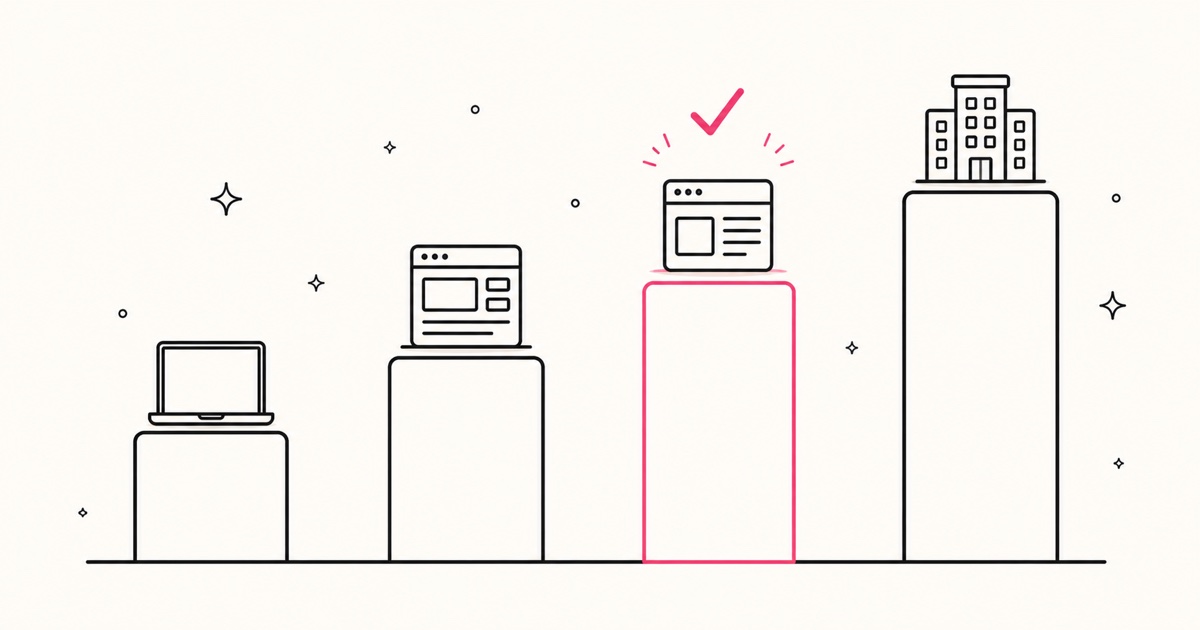
Ask five people how much a small business website should cost and you'll get five different numbers, none of which explain themselves. That's not confusion: it's because "website" isn't one product. A landing page, a five-page brochure site, and a fully custom build are as different as a bicycle, a sedan, and a delivery truck, and they're priced accordingly.
Here's the real 2026 breakdown, what you're actually paying for at each tier, the hidden costs almost nobody mentions upfront, and (more importantly) why the price tag has almost nothing to do with whether the site makes you money.
The four real price tiers
Strip away the sales pitches and small business websites cluster into four honest tiers:
- DIY builders (Squarespace, Wix, Shopify): $0–$50/month. You're paying for software, not strategy. Fine for a hobby or a proof-of-concept; risky as the only site for a business that depends on being found and trusted. The hidden cost here is your own time: a DIY build that "just takes a weekend" routinely eats 20–40 hours once you factor in copywriting, photo selection, and the inevitable redo after you look at it with fresh eyes.
- Freelancers and template sites: $1,000–$5,000. A real person builds it, usually on a theme. Quality varies wildly with the freelancer's skill and how much strategy (versus just design) is actually included. Ask specifically whether copywriting is in scope; it's the single most common thing quietly excluded at this tier.
- Small agencies: $5,000–$15,000. Custom design, some strategy, a project manager keeping things on track. This is where most "professional" small business sites land, and where the gap between "looks good" and "converts well" starts to matter most, because the budget is big enough that a miss is expensive.
- Full-service or branding agencies: $15,000–$50,000+. Custom everything, often bundled with a broader rebrand: the going rate for a business willing to pay for an agency's full attention and the overhead that comes with it. At this tier you're also usually buying ongoing strategic input, not just a one-time build.
| Tier | Typical cost | Best fit | Watch for |
|---|---|---|---|
| DIY builder | $0–$50/month | Hobby, test, or temporary proof-of-concept | Your own time becomes the real cost |
| Freelancer/template | $1,000–$5,000 | Simple small business site with clear needs | Copywriting and strategy may be excluded |
| Small agency | $5,000–$15,000 | Professional site where trust and conversion matter | Good design still may not equal conversion |
| Full-service agency | $15,000–$50,000+ | Rebrand, complex scope, or larger organization | You may pay for overhead you do not need |
Why the price tag doesn't predict the result
Here's the uncomfortable part: none of those four tiers reliably predicts whether the resulting site turns visitors into customers. A gorgeous $30,000 site with no clear path to booking a call converts worse than a plain $2,000 page with one obvious next step. We've seen both directions: an expensive site that looked incredible and generated nothing, and a scrappy one-pager that quietly out-performed it.
That's because most website pricing is priced on production: design hours, pages built, revisions included, not on whether the thing produces customers. You can buy a lot of production and still end up with an expensive brochure. Production and conversion are different skills, and most quotes only price the first one.
This is also why "just get a nicer website" is such common, and commonly wrong, advice. A site's visual quality and its ability to turn a stranger into a lead are related but separable variables. Fixing the wrong one wastes money and buys you a better-looking version of the same problem.
What you're actually paying for at each tier
Once you see it this way, the real differences make more sense:
- At the low end, you're paying for a template and your own time to fill it in. The software did the hard part decades ago; you're renting access to it.
- In the middle, you're paying for someone else's time and design judgment: a real trade of money for hours you don't have to spend.
- At the top, you're paying for an agency's overhead (account managers, meetings, a bigger team) as much as for the website itself. Some businesses genuinely need that layer of service. Most small businesses are paying for it without needing it.
Strategy (the part that actually decides whether the site converts) is a thin, optional layer at every tier unless you specifically ask for it and pay for it separately. This is the single most important sentence in this article: ask every provider, at every tier, exactly what strategic work is included versus what's just design and build. The answer tells you more about the quote than the number does.
The hidden costs nobody mentions upfront
Almost every published website price is the build cost, not the total cost. Before you commit to a number, budget for these separately:
- Copywriting. Someone has to write the words that actually sell. Many quotes assume you'll supply this yourself, which is fine, if you know that going in.
- Photography. Stock photos are free and instantly recognizable as stock photos. Real photos of your actual business cost money (or your own time) but do more trust-building work than almost anything else on the page.
- Hosting and domain. Usually $10–$30/month, small but recurring, and easy to forget when comparing a one-time build quote.
- Maintenance and updates. Plugins, security patches, content updates six months after launch. Ask upfront who does this and what it costs: "the site is done" and "the site stays working" are two different promises.
- SEO and ongoing visibility. A website with zero traffic converts zero visitors regardless of how well it's built. If nobody's driving attention to it, budget for that separately too.
Add these up before comparing quotes. A $2,000 freelancer site plus $1,500 in copy, photos, and setup can cost more than a $3,000 quote that bundles everything, and the bundled version is usually the better deal, even at a higher headline price.
The question that actually matters
Before asking "how much should this cost," ask "what is this website supposed to do?" A single-location restaurant needs hours, a menu, and a map: that's a $1,500 problem, not a $15,000 one. A B2B company selling a $40,000 service needs a site that builds credibility and pre-sells a sales call: that's worth real investment, because a bad first impression costs you deals you'll never see. Price should follow the job the site has to do, not the other way around.
A simple framework for setting your own budget
If you want a number before you get on a call with anyone, work through these four questions honestly:
- What's the average value of a customer to your business? A website budget should be sized relative to what a single conversion is worth, not to what feels comfortable to spend.
- How many of your leads currently come from search or your website at all? If the answer is "basically none," a modest, well-built site that starts capturing search traffic will outperform an expensive one nobody finds.
- Does a visitor need to trust you before they buy, or do they just need to find you? A plumber taking same-day calls needs speed and a phone number. A consultant closing five-figure retainers needs a site that does real credibility-building work before the first call.
- What happens six months after launch? If the honest answer is "nothing, it just sits there," budget less for the build and more for whatever keeps bringing people to it: content, SEO, ads.
How we price it differently
We don't sell websites by the hour or by the page. Every website we build is scoped and fixed-priced on a single call, based on what your business actually needs, not a package tier you have to squeeze into. That scoping call walks through the exact framework above: what the site needs to do, who it needs to convince, and what happens after launch. No surprise change orders, no "that'll be extra" three weeks in. You'll know the number before you commit to anything.
Research Confidence
This article is based on:
- Direct observations from small business website scoping and conversion conversations
- Multiple website project patterns across DIY, freelancer, and agency-style builds
- Publicly visible pricing and package patterns in the small business website market
- Hypotheses still being tested around how much strategic scope a small business site actually needs
Confidence Level: Normal
FAQ
How much does a small business website typically cost in 2026?
Anywhere from free (DIY builders) to $50,000+ (full custom agency builds), with most professional small business sites landing between $1,500 and $15,000 depending on scope and who builds it.
Why do website prices vary so much between providers?
You're paying for different things at each tier: software and your own time at the low end, a freelancer's or agency's design hours in the middle, and an agency's overhead and account management at the top. Strategy is usually a separate, optional cost at every tier.
Does a more expensive website convert better?
Not reliably. Conversion depends on whether the site has one clear next step for a visitor to take, not on design budget. Plenty of expensive sites generate nothing, and plenty of simple ones convert well.
What should determine my website budget?
The job the site has to do. A single-location local business needs far less than a company selling a high-ticket service that has to build credibility before a sales call. Match the investment to the job, not to a generic package tier.
How does Design Delulu price website projects?
We scope and fix-price every website on a free call based on your specific business: no hourly billing, no package you have to fit into, and no surprise costs after you commit.
Ready to turn attention into customers?
Book a free discovery call and let's map your growth system.
Free Marketing Audit Or book a strategy call