
The Delulu Blog
Website first or content first? The order most businesses get wrong

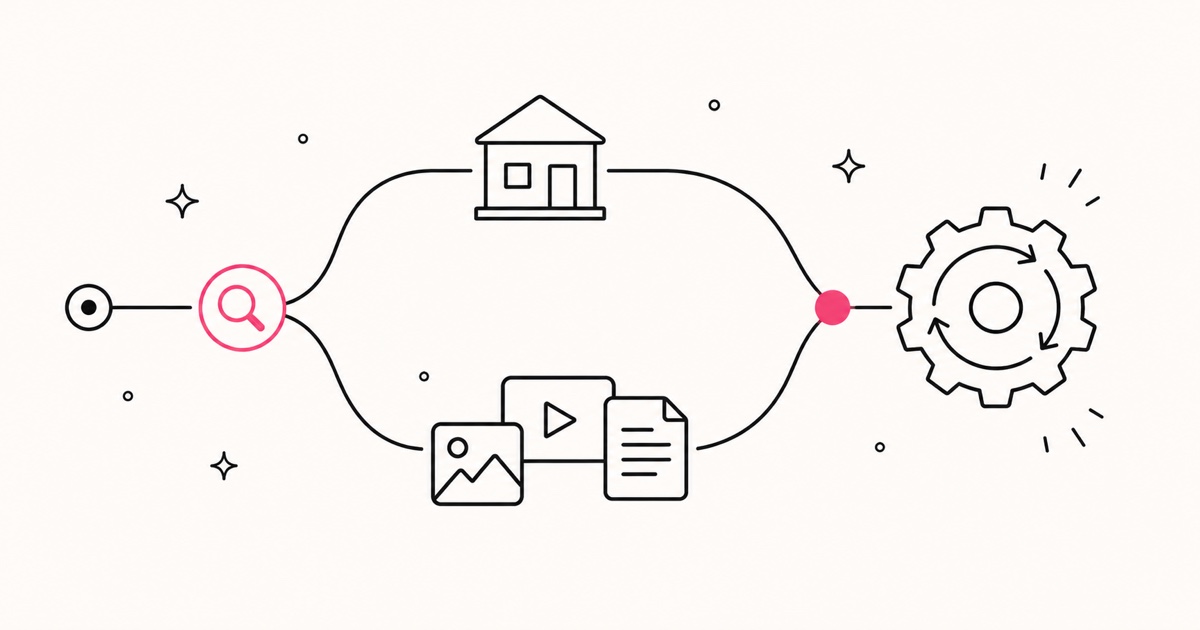
It's a real question, and most of the advice out there answers it badly: build the website first, then do marketing, or the opposite, post content first and "the website can wait." Both answers are wrong for the same reason. They treat the website and the content as two separate projects instead of one system.
What happens when you do content first with a broken website
You run ads, post consistently, maybe even go a little viral, and the traffic arrives at a website that's slow, confusing, or has no clear next step. You just paid, in money or time, to send people through a leaky pipe. The content did its job. The foundation wasn't there to catch what it produced.
Here's what this actually looks like week to week: engagement climbs, comments and shares look healthy, the numbers that show up on a dashboard all point up and to the right, and inquiries stay flat. The business owner starts to suspect the content isn't working, when the real problem is one step downstream. Doubling down on content at that point just means paying more to lose more people at the same broken step.
What happens when you build the perfect website first and stop
The opposite trap is just as common: months spent on the "perfect" website, and then it sits there with almost no traffic, because nobody's actually generating attention for it. A beautiful, empty storefront is not a growth strategy. The most common version of this trap is treating the website launch as the finish line instead of the starting line.
This version is quieter and easier to miss, because nothing is visibly broken. The site works, it looks good, everyone who sees it likes it, but "everyone who sees it" is a tiny number, because nothing is driving anyone there. A perfect website with ten visitors a month will always lose to a decent website with a thousand.
So which comes first?
Neither, exactly. The real answer is: find out which one is actually broken, and fix that one fast, without waiting for the other to be perfect. Most existing businesses already have some of both: an old website and some kind of presence. The question isn't "website or content," it's "which piece of what I already have is actually costing me customers right now."
That's a different question for a business with a decent site and zero content than it is for a business with a great following and a site that quietly repels every visitor it sends there. Diagnose before you build.
| What you see | Likely problem | Fix first |
|---|---|---|
| Traffic exists, inquiries are weak | The website is leaking attention | Conversion path, speed, trust, CTA |
| The site is solid, but nobody visits | Visibility is the gap | Content, SEO, distribution |
| Both site and content are weak | The system is underbuilt | Get the site to good enough, then start the engine |
A worked example
Picture a local service business with a five-year-old website and an active Instagram. Traffic from social is decent: a few hundred visitors a month land on the site. Inquiries, though, are almost zero. That's a website problem: the traffic exists, it just isn't converting once it arrives. The fix here is not "post more": it's fixing whatever's broken on the site (speed, a missing call to action, a confusing homepage) before spending another dollar on content.
Now picture the reverse: a business with a genuinely solid website: fast, clear, one obvious next step, but almost no visitors, and no content presence anywhere. That's a visibility problem. A better website won't fix an empty parking lot. The fix is building the content engine that gets people there in the first place.
Same two ingredients, opposite diagnosis, opposite fix. Skipping the diagnosis and guessing wastes budget on the ingredient that was never the problem.
The order that actually works
- Fix the foundation to "good enough," not "perfect." The website needs a clear next step, reasonable speed, and basic trust signals, not a total rebuild, before it's worth sending anyone to it.
- Start the content engine as soon as the foundation can catch what it produces. Don't wait for a flawless site; wait for one that won't waste the attention you're about to earn.
- Let the two improve each other. Content tells you what visitors actually want to know, which improves the site. A better site converts more of the traffic content brings, which makes the content worth more. Run them together and each one makes the other more valuable.
Signals that tell you which one is actually broken
If you're not sure which side of this you're on, look for these patterns rather than guessing:
- Decent traffic, few inquiries → the website is the leak. Look at load speed, whether there's one obvious next step, and whether the site gives a stranger a reason to trust you in the first ten seconds.
- Solid site, almost no visitors → the content and visibility side is the gap. The site isn't the problem; nobody's finding it.
- Both are thin → this is the most common starting point for a new or overlooked business. Fix the website to "good enough" first (it's usually the faster, cheaper fix), then start the engine immediately after, not months later.
Why this trips up so many businesses
Website designers sell websites. Content agencies sell content. Neither one is set up to tell you the other might be the actual problem, so businesses get sold whichever product the vendor in front of them happens to sell, in whatever order that vendor needs to hit quota. The businesses that get this right diagnosed the actual gap first, instead of assuming the answer.
The takeaway
Stop asking "website or content, and in what order." Ask "which one is actually broken right now": fix that one enough to stop losing people, then run both together. The machine only works once the foundation and the content are connected; building either one in isolation just delays the moment they finally have to work together.
Research Confidence
This article is based on:
- Direct observations from website and content sequencing decisions
- Multiple small business patterns where traffic, trust, and conversion were solved in the wrong order
- Search and platform behavior patterns around demand creation and destination quality
- Hypotheses still being tested around which bottlenecks deserve priority in different business stages
Confidence Level: Normal
FAQ
Should I build my website or start content marketing first?
Neither by default: diagnose which one is actually costing you customers right now, fix that one to good enough, and then run both together. Treating them as sequential steps instead of one system is the most common mistake.
What happens if I run content campaigns before fixing my website?
You spend money and effort generating attention that arrives at a site that can't convert it: the equivalent of advertising a store with a locked door. Fix the basics first: a clear next step, reasonable speed, visible trust signals.
Is it a waste to launch a website before starting content?
Only if you stop there. A website with no content driving traffic to it just sits empty. The launch should be the start of attracting attention, not the finish line.
How do I know which one (my website or my content) is the real problem?
Look at where the process actually breaks: if you have decent traffic but few inquiries, the website is the leak. If you have a solid site but almost no visitors, the content and visibility side is the gap.
Can Design Delulu handle both the website and the content system?
Yes: that's the point. We build both as one connected system instead of two disconnected vendors solving different halves of the same problem.
Ready to turn attention into customers?
Book a free discovery call and let's map your growth system.
Free Marketing Audit Or book a strategy call